Band 5.0 IELTS Writing Task 1 Model Answer
Overall Band Score: 5.0 · Cambridge IELTS 11 · 2026-11-21
IELTS Writing Task 1 question
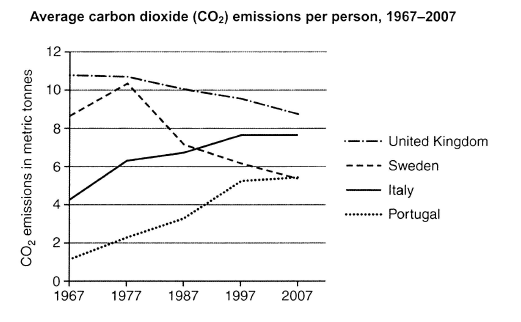
The graph below shows average carbon dioxide (CO2) emissions per person in the United Kingdom, Sweden, Italy and Portugal between 1967 and 2007.
Summarise the information by selecting and reporting the main features, and make comparisons where relevant.
Student answer (Band 5.0)
The average carbon dioxide emission per person in the united kingdom,sweden,italy and portugal between 1967 and 2007.in the united kingdom carbon dioxide emission in metric tonnes are between the start with eleven in 1967 and the passage of time in 2007 the range of person are decrease and reach at nine.in the sweaden,ratio of person start with 9 in 1967 and acros the time reach to the 5.in the italy the ratio of carbon dioxide person in 1967 are 4.5 and the 1977 are increase butt with the passage of time the ratio are increase and reach 7.5.and the portugal the carbon dioxide in the start are 1 and incrase with the time.and in the 2007 are also increase and reach4.5.
AI examiner evaluation
| Criterion | Band |
|---|---|
| Task Achievement / Task Response | 4.5 |
| Coherence and Cohesion | 4.5 |
| Lexical Resource | 5.0 |
| Grammatical Range and Accuracy | 5.0 |
| Overall | 5.0 |
Task Achievement / Task Response: Band 4.5
You identify the four countries and give some relevant figures and trends, including the UK’s decline and Italy’s rise. However, the report is incomplete: it has no clear overview of the main features, and several details are inaccurate or unclear. For example, Sweden rises to about 10 tonnes in 1977 before falling, but this important peak is omitted; Portugal reaches about 5.4 tonnes in 2007, not 4.5. The response also contains only 110 words, below the required 150, so there is not enough detail to summarise the graph adequately. Add a concise overview, report the key turning points and end values accurately, and develop the comparisons between countries.
Coherence and Cohesion: Band 4.5
The response follows a basic country-by-country order, which gives the reader some sense of how the information is organised. However, it is presented as one continuous paragraph, with no clear introduction or overview separating the main trends from details. Connections such as “with the passage of time” are repeated and do not always make the relationships between figures clear. The opening is also a sentence fragment, so the report does not establish its purpose cleanly. Use separate paragraphs for an introduction and overview, then group the detailed comparisons logically. Linking phrases such as “by contrast” and “while” would help show how the countries’ trends differ.
Lexical Resource: Band 5.0
You use some relevant topic vocabulary, including “carbon dioxide,” “metric tonnes,” “decrease,” and “increase,” so the subject is generally recognisable. However, the range is limited and several expressions are inaccurate or awkward, such as “ratio of person” and “the range of person.” Repetition of “with the passage of time” also makes the description less precise. There are spelling errors, including “sweaden,” “acros,” and “incrase,” which reduce clarity. Aim to use standard graph-description terms and accurate collocations, for example “per-person emissions,” “rose to,” “fell to,” and “remained stable.” Check spelling carefully, especially for country names and common trend verbs.
Grammatical Range and Accuracy: Band 5.0
The response attempts to describe changes over time using simple clauses and some longer sentences, but the grammatical range is limited and errors occur frequently. The opening, “The average carbon dioxide emission … between 1967 and 2007,” is a fragment rather than a complete sentence. There are also problems with articles, agreement, and verb forms, as in “the ratio … are increase” and “the 1977 are increase.” Punctuation and spacing are inconsistent, making some sentences difficult to follow. Practise complete subject–verb sentences in the past tense, such as “Emissions in Italy rose from about 4 tonnes in 1967 to nearly 8 tonnes in 1997,” and use full stops to separate each main point.
See this exact question answered at other band scores. The same prompt compared across bands.
Browse more IELTS Writing model answers or get your own writing scored by the same AI examiner.