Band 6.0 IELTS Writing Task 1 Model Answer
Overall Band Score: 6.0 · Cambridge IELTS 11 · 2026-11-23
IELTS Writing Task 1 question
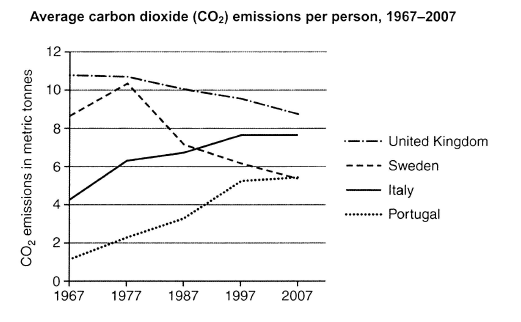
The graph below shows average carbon dioxide (CO2) emissions per person in the United Kingdom, Sweden, Italy and Portugal between 1967 and 2007.
Summarise the information by selecting and reporting the main features, and make comparisons where relevant.
Student answer (Band 6.0)
The line graph represents the average carbon dioxide emission in metric tonnes of every person in the UK, Sweden, Italy and portugal during the period of 1967 to 2007.
The overall perspective shows that, Portugal had the lowest emission and with time it kept increasing, inversely the UK had the most CO2 emission which gradually decreased over time.
Although, Portugal's emission was measured 1 tonn in 1967, it kept increasing and came at a point of 5.5 tonnes (in 2007) which was also the Sweden's emission in the same year, after decreasing from 10 tonnes in 1977. In Italy, per person's emission was at about 4 tonnes (in 1967) which increased upto almost 8 tonnes till 2007. United Kingdom was the only country who's carbon dioxide emission constantly kept decreasing although it was the most in the initial year. It went till 8.5 tonnes which was a great achievment for them.
AI examiner evaluation
| Criterion | Band |
|---|---|
| Task Achievement / Task Response | 6.0 |
| Coherence and Cohesion | 6.0 |
| Lexical Resource | 6.0 |
| Grammatical Range and Accuracy | 5.5 |
| Overall | 6.0 |
Task Achievement / Task Response: Band 6.0
You identify the overall contrast accurately: Portugal’s emissions rose from the lowest level, while the UK remained highest and declined. You also report several relevant figures, including Portugal reaching about 5.5 tonnes and Italy rising to nearly 8 tonnes. However, the overview is incomplete because it omits Sweden’s sharp rise to a peak in 1977 followed by a sustained fall, and it does not clearly compare Italy’s eventual level with the UK’s. The claim that the UK’s reduction was “a great achievement for them” adds an unsupported evaluation rather than describing the data. A fuller overview and more precise comparisons across all four countries would make the key features more complete and clearly developed.
Coherence and Cohesion: Band 6.0
The response has a clear basic structure: an introduction, an overview, and a paragraph describing country trends. The sequence from the general pattern to individual figures is easy to follow, and linking expressions such as “Although” and “In Italy” help signal shifts. However, the overview and details are not fully coordinated: Sweden’s trend is mentioned only briefly, while the UK and Portugal receive more attention, and the final evaluative comment interrupts the data-focused progression. Some linking is also awkward, as in “Although, Portugal’s emission…” and “inversely.” Grouping the countries by contrasting trends and using clearer references would create smoother progression and more effective cohesion.
Lexical Resource: Band 6.0
You use an adequate range of topic vocabulary, including “emission,” “gradually decreased,” “increased,” and “initial year,” so the main trends are understandable. There are also attempts at more descriptive phrasing, such as “overall perspective.” However, several choices are imprecise or unnatural for a graph report: “emission of every person” is less suitable than “per-person emissions,” and “came at a point” does not clearly describe a value reaching a level. “A great achievement” is evaluative and inappropriate for neutral reporting. Spelling and form errors such as “portugal,” “tonn,” and “achievment” also reduce accuracy. More precise trend verbs and standard collocations would improve control.
Grammatical Range and Accuracy: Band 5.5
You attempt a mixture of simple and complex sentences, including a relative clause in “which gradually decreased over time” and a contrast introduced with “Although.” Most of the meaning remains clear, but some grammatical errors recur. For example, “Although, Portugal’s emission was measured 1 tonn” has faulty punctuation and an awkward passive construction; “it kept increasing and came at a point” also has an unclear clause structure. In “the Sweden’s emission,” the article is incorrectly used, and “the only country who's carbon dioxide emission” has an incorrect relative form and possessive structure. Work on articles, clause construction, and punctuation while retaining your attempts at complex sentences.
See this exact question answered at other band scores. The same prompt compared across bands.
Browse more IELTS Writing model answers or get your own writing scored by the same AI examiner.