Band 6.0 IELTS Writing Task 1 Model Answer
Overall Band Score: 6.0 · Cambridge IELTS 11 · 2026-11-25
IELTS Writing Task 1 question
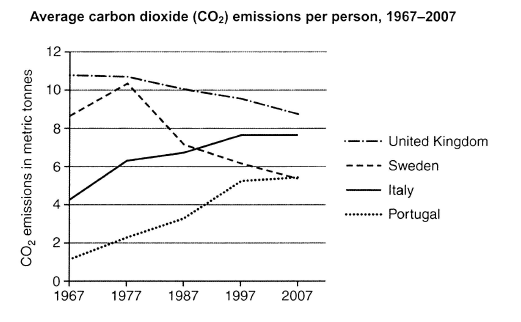
The graph below shows average carbon dioxide (CO2) emissions per person in the United Kingdom, Sweden, Italy and Portugal between 1967 and 2007.
Summarise the information by selecting and reporting the main features, and make comparisons where relevant.
Student answer (Band 6.0)
The given line graph is illustrating the information about the average carbon dioxide emissions per individual in the United Kingdom, Sweden, Italy, and Portugal from 1967 to 2007.
Overall, portugal had least carbon dioxide emissions whereas United Kindom had the highest amount of CO2.
In detail, In 1967, United kindom and sweden had the carbon dioxide around eight or 10 tonnes. In 2007, these countries stood at the eight and less than six tonnes, both these nations experienced an downward trend throughout the time period.
Next, in Italy and Portugal the emissions of carbon dioxide reached at more than four and less two metric tonnes in 1967. However, in 2007, they reached more than six and four metric tonnes, which is generally showing an upward trend. Subsequently, all nations show the fluctuations mainly in year 1987 and 1977. This chart gives an overview of CO2 emissions in metric tonnes per person.
AI examiner evaluation
| Criterion | Band |
|---|---|
| Task Achievement / Task Response | 5.5 |
| Coherence and Cohesion | 6.0 |
| Lexical Resource | 6.0 |
| Grammatical Range and Accuracy | 5.5 |
| Overall | 6.0 |
Task Achievement / Task Response: Band 5.5
You identify the overall contrast correctly: the UK had the highest emissions and Portugal the lowest at the beginning, while the UK and Sweden declined and Italy and Portugal generally rose. However, the overview is incomplete because it does not mention that Italy finished level with Sweden, or that the UK remained highest in 2007. Several figures are also too vague: “around eight or 10 tonnes” and “the eight and less than six tonnes” do not clearly report the countries’ values. The claim that all nations fluctuated mainly in 1977 and 1987 is unclear and does not capture the main patterns. The response is 143 words, below the required 150, which limits the detail provided.
Coherence and Cohesion: Band 6.0
The response has a recognisable structure: an introduction, an overview, and two paragraphs grouping the declining and rising countries. This makes the main comparison reasonably easy to follow. Linking expressions such as “Overall,” “In detail,” and “Next” help signal stages, although “Subsequently” introduces a point that is not clearly connected to the preceding comparison. The final sentence repeats the task rather than adding a useful concluding comparison. Some references, including “these countries” and “they,” require the reader to infer which figures or countries are meant. To improve progression, organise the details by clear time periods or trends and use more precise references.
Lexical Resource: Band 6.0
You use an adequate range of task-related vocabulary, including “emissions,” “metric tonnes,” “downward trend,” and “upward trend,” so the topic remains clear. There are also attempts to vary wording, such as “per individual” and “per person.” However, some choices are inaccurate or awkward: “reached at” is not a natural collocation, and “had least carbon dioxide emissions” needs a clearer comparative form. Country names are inconsistently capitalised and misspelled (“portugal,” “United Kindom,” “United kindom”), which weakens accuracy. Repeated use of “carbon dioxide emissions” also makes the response less flexible. More precise trend vocabulary and accurate country names would strengthen the report.
Grammatical Range and Accuracy: Band 5.5
You use both simple statements and some longer structures, including the contrast introduced by “However,” and the clause beginning “whereas.” The main meaning is generally understandable, but several grammatical errors remain. For example, “portugal had least” is missing an article or comparative construction, while “both these nations experienced an downward trend” has an incorrect article. The sentence beginning “Next, in Italy and Portugal…” shifts awkwardly between “reached” and “showing,” and “Subsequently, all nations show” uses a present tense where the report describes past data. Capitalisation and punctuation are also inconsistent, particularly after sentence openings. Aim for accurate past-tense comparisons and check articles and sentence boundaries.
See this exact question answered at other band scores. The same prompt compared across bands.
Browse more IELTS Writing model answers or get your own writing scored by the same AI examiner.