Band 5.0 IELTS Writing Task 1 Model Answer
Overall Band Score: 5.0 · Cambridge IELTS 11 · 2026-11-28
IELTS Writing Task 1 question
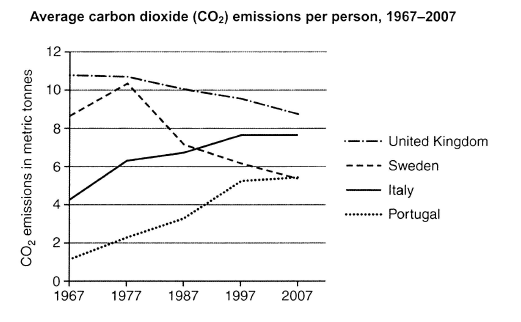
The graph below shows average carbon dioxide (CO2) emissions per person in the United Kingdom, Sweden, Italy and Portugal between 1967 and 2007.
Summarise the information by selecting and reporting the main features, and make comparisons where relevant.
Student answer (Band 5.0)
The graph illustrates average carbon dioxide emissions per person in the united kingdom, sweden, italy and portugal between 1967 and 2007.
Overall, it is evident that the four countries have different CO2 emissions in metric tonnes especially in 1967.
First, United Kingdom has a high CO2 emmissions more than 10 and it kept dropping slowly.
Sencond, Sweden had a small rise between 1967 and 1977 then it fall dramatically from 10 to 6.
Third, Italy kept increasing slightly from 4 to 8.
Finally, Portugal was having a low CO2 emissions less thn 2 then it rose steadly until it reaches almost 6.
AI examiner evaluation
| Criterion | Band |
|---|---|
| Task Achievement / Task Response | 4.0 |
| Coherence and Cohesion | 5.5 |
| Lexical Resource | 5.5 |
| Grammatical Range and Accuracy | 5.0 |
| Overall | 5.0 |
Task Achievement / Task Response: Band 4.0
You identify the graph’s subject and describe the broad direction of all four countries, including the UK’s decline and the rises in Italy and Portugal. However, the overview is vague: saying the countries had “different CO2 emissions” does not highlight the key comparisons, such as the UK remaining highest throughout and Portugal starting lowest before catching up with Sweden by 2007. Some details are inaccurate or imprecise: Sweden rose to about 10 in 1977, then fell to around 5.4 by 2007, not merely “from 10 to 6”; Italy levelled off at about 7.6 after 1997. The response is also 87 words, below the 150-word minimum; 15 words copied from the prompt were excluded. Add a clearer overview and more accurate endpoint comparisons.
Coherence and Cohesion: Band 5.5
The response has a basic, understandable sequence: an introduction, a general statement, and then comments on each country. The signposts “First,” “Second,” “Third,” and “Finally” help readers follow the order, and the country-by-country approach is appropriate. However, the progression is mechanical, and the overview does not effectively prepare the reader for the comparisons that follow. The short statements are mostly isolated rather than linked to show how the countries compare or how trends change over time. For example, Sweden’s fall and Italy’s rise could be connected to explain their changing relative positions. Grouping countries with similar trends and using clearer links between overview and details would make the organisation more cohesive.
Lexical Resource: Band 5.5
You use relevant task vocabulary, including “emissions,” “per person,” “rise,” “dropping,” and “increasing,” so the main trends are generally understandable. The range is limited, however, and several phrases are imprecise or awkward, such as “a high CO2 emmissions,” “a small rise,” and “was having a low CO2 emissions.” Spelling errors—“emmissions,” “Sencond,” “thn,” and “steadly”—also reduce accuracy. Try using precise trend language and collocations, such as “emissions stood at,” “declined gradually,” and “rose steadily.” Avoid repeating the same basic verbs, and use “tonnes per person” when reporting the measurement. These changes would make the description more natural and exact.
Grammatical Range and Accuracy: Band 5.0
You communicate the main ideas using simple sentences, and the opening sentence gives the time period and countries clearly. There is an attempt to vary sentence openings with sequencing words, but most of the response relies on short, basic structures, so the grammatical range is limited. Several errors affect sentence accuracy: “United Kingdom has” needs an article and a past-tense verb (“The United Kingdom had”); “then it fall” should be “then it fell”; and “until it reaches” should be “until it reached” to keep the past-time frame consistent. In “a low CO2 emissions,” the article and plural noun do not agree. Practise accurate past-tense reporting and combine related trends into longer, controlled sentences.
See this exact question answered at other band scores. The same prompt compared across bands.
Browse more IELTS Writing model answers or get your own writing scored by the same AI examiner.