Band 6.0 IELTS Writing Task 1 Model Answer
Overall Band Score: 6.0 · Cambridge IELTS 11 · 2026-11-05
IELTS Writing Task 1 question
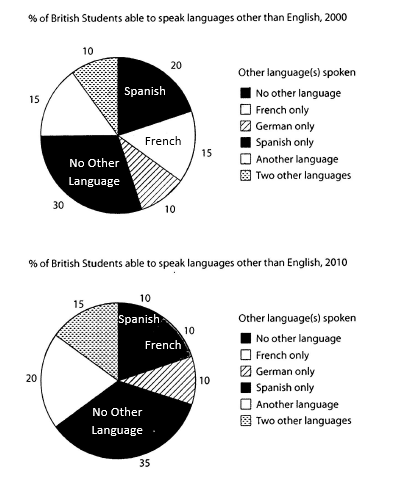
The charts below show the proportions of British students at one university in England who were able to speak other languages in addition to English, in 2000 and 2010
Summarise the information by selecting and reporting the main features, and make comparisons where relevant.
Student answer (Band 6.0)
The pie charts compare the proportions of British students at one University in England who could speak other languages along with English in 2000 and 2010.
Overall, the ratio of cohort speaking no other language is the largest in both years. Spanish and French are more common along side English, while the ratio of cohort speaking german remain same in the years.
In 2000, the ratio speaking no other languages is 30%. And the ratio of speaking Spanish is more, accounted for 20%. The ratio of French and another language is 15% each. While the ratio of two other language and German only is 10% apiece.
In 2010, the ratio of no other language became 35%, increasing 5%. French and Spanish became less common: Spanish ratio halved to 10% and French fall to 10%. In contrast, ratio of two other language and another language, both increased by 5%, rosed to 20% and 15% respectivey. Meanwhile, the rartio of German only reamined constant at 10%.
AI examiner evaluation
| Criterion | Band |
|---|---|
| Task Achievement / Task Response | 6.5 |
| Coherence and Cohesion | 6.5 |
| Lexical Resource | 5.5 |
| Grammatical Range and Accuracy | 5.5 |
| Overall | 6.0 |
Task Achievement / Task Response: Band 6.5
You cover both years and report the main pattern accurately: students speaking no other language form the largest group in each year, while German-only remains at 10%. The figures for Spanish, French, and the two “other” categories are also correctly compared, including the fall in Spanish and the rises in the other-language groups. This gives the response a clear overview and relevant supporting detail. Some phrasing makes the comparisons less precise—for example, “Spanish and French are more common” does not specify the year or distinguish their different trends—and the overview could summarise the overall shift more directly. To strengthen the report, state that the no-other-language share rose while Spanish and French declined, alongside growth in the other categories.
Coherence and Cohesion: Band 6.5
The response has a clear, useful structure: an introduction, an overview, and separate paragraphs for 2000 and 2010. This makes the information easy to follow, and time markers such as “In 2000” and “In 2010” guide the reader through the comparison. However, some connections are mechanical or incomplete. The sentence beginning “While the ratio of two other language…” is a fragment, and repeated use of “the ratio” makes the progression sound formulaic. The overview also groups Spanish and French together as more common without clarifying their contrasting changes. Use complete sentences and vary the links between categories—for example, contrast the declining language shares with the growing “another language” and “two other languages” groups.
Lexical Resource: Band 5.5
You use relevant vocabulary for describing charts, including “proportions,” “accounted for,” “halved,” “increased,” and “remained constant.” These choices communicate the main trends, but the range is limited by repeated reliance on “ratio” and “became,” and several word-choice, collocation, and spelling errors reduce precision. For example, “ratio of cohort” is not a natural way to describe these percentages, while “more common along side English” is awkwardly phrased. There are also misspellings such as “respectivey” and “rartio.” Aim for more precise terms such as “share” or “proportion,” and check spelling and collocations carefully so that the vocabulary supports the otherwise clear comparisons.
Grammatical Range and Accuracy: Band 5.5
You attempt both simple and more complex forms, including the overview sentence with “while” and the comparison “In contrast…”. Most of the intended meaning remains understandable, but some grammatical errors recur and a few sentences are incomplete. “The ratio of cohort speaking no other language is the largest” has an unclear noun phrase, and “While the ratio of two other language and German only is 10% apiece” is a subordinate clause without a main clause. There are also agreement and tense problems in “German remain same” and “French fall to 10%.” Improve control by using complete clauses and checking subject–verb agreement, articles, and tense consistency; for example, “The proportion speaking German remained unchanged at 10%.”
See this exact question answered at other band scores. The same prompt compared across bands.
Browse more IELTS Writing model answers or get your own writing scored by the same AI examiner.