Band 5.5 IELTS Writing Task 1 Model Answer
Overall Band Score: 5.5 · Cambridge IELTS 11 · 2026-11-05
IELTS Writing Task 1 question
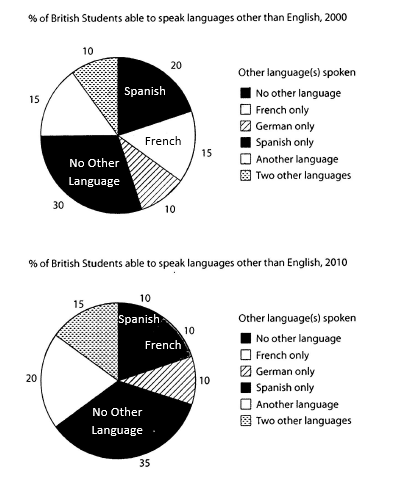
The charts below show the proportions of British students at one university in England who were able to speak other languages in addition to English, in 2000 and 2010
Summarise the information by selecting and reporting the main features, and make comparisons where relevant.
Student answer (Band 5.5)
The pie chart illustrates the ranges of british students in 2000 and 2010 of an England university who could speak other languages alongside English.
Overall, in both years 2000 and 2010 the proportion of no other language remained the largest, the german only remained the same whilst all other decreased.
In 2000 the proportion of no other language dominated with 30% followed by spanish with 20%. Whereas the percentage of French and another language was 15 and 10% for german only and two other languages.
Similarly in 2010, the proportion of no other language increased to 35% followed by another language at 20% and other two languages at 15%. While German only, spanish and french has the proportions of 10%.
AI examiner evaluation
| Criterion | Band |
|---|---|
| Task Achievement / Task Response | 5.5 |
| Coherence and Cohesion | 6.0 |
| Lexical Resource | 5.5 |
| Grammatical Range and Accuracy | 5.5 |
| Overall | 5.5 |
Task Achievement / Task Response: Band 5.5
You identify the main feature that “No other language” was the largest category in both years, and you report several figures accurately, including 30% and 35% for this group and 10% for German only in both years. However, the overview says “all other decreased,” which is not supported: “Another language” rose from 15% to 20%, and “Two other languages” rose from 10% to 15%. The 2000 figures for French and “Another language” are also unclear and appear to be reversed or combined. The response is under the required 150 words, which limits how fully you can report and compare the data. Include the key increases and decreases in a clearer overview and develop the comparisons.
Coherence and Cohesion: Band 6.0
The response has a recognisable structure: an introduction, an overview, and separate descriptions of the two years. This makes the information reasonably easy to follow. However, the progression is weakened by unclear links and sentence fragments, such as “Whereas the percentage of French and another language was 15 and 10% for german only and two other languages.” The reader cannot confidently match each figure to its category. “Similarly in 2010” also suggests a similarity, although several proportions changed. Use complete sentences and organise the figures into clear comparisons—for example, group categories that rose, fell, or stayed unchanged. More precise linking would make the cohesion less mechanical and the comparisons easier to track.
Lexical Resource: Band 5.5
You use relevant chart vocabulary, including “proportion,” “percentage,” “followed by,” and “increased,” so the topic is generally clear. However, the range is limited and some choices are inaccurate or repetitive. “Ranges” is not the right word for the categories shown, and “dominated” is less suitable than a neutral description such as “accounted for the largest share.” Several category labels are also inconsistent: “other two languages” should be “two other languages,” while “another language” is a distinct category. Capitalisation is inconsistent in “british,” “german,” and “spanish.” Aim for precise, consistent labels and use a wider range of accurate verbs to describe changes, such as “rose,” “fell,” and “remained stable.”
Grammatical Range and Accuracy: Band 5.5
You attempt both simple and more complex sentence forms, and the main message is usually understandable. However, some grammatical errors affect clarity. The opening phrase “the ranges of british students … of an England university” has an unclear structure, and “the german only remained the same” lacks a clear grammatical reference to the proportion. In “french has the proportions of 10%,” the plural subject requires “have,” and the phrasing needs a clearer construction. The sentence beginning “Whereas” is incomplete, and the final sentence beginning “While” is also a fragment. Use complete clauses, check subject–verb agreement and tense, and make sure each comparison has a clear subject and verb.
See this exact question answered at other band scores. The same prompt compared across bands.
Browse more IELTS Writing model answers or get your own writing scored by the same AI examiner.