Band 4.5 IELTS Writing Task 1 Model Answer
Overall Band Score: 4.5 · Cambridge IELTS 11 · 2026-11-06
IELTS Writing Task 1 question
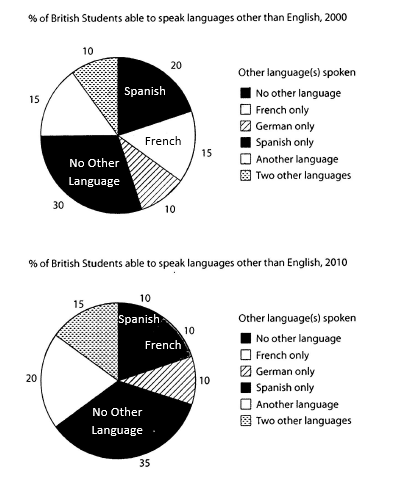
The charts below show the proportions of British students at one university in England who were able to speak other languages in addition to English, in 2000 and 2010
Summarise the information by selecting and reporting the main features, and make comparisons where relevant.
Student answer (Band 4.5)
the british students from university of england can speak other leanguages in 2000 and 2010.
overall, students can speak more than one languages is really a good things.
in 2000, 15 students can speak more than two languages and 15 students able to speak more than two languages. and 30 students can only speak one language. and many of them also can speak french , german, and spanish.
by 2010, 10 british students able to speak more than one languages and 20 students can speak another language. 35 students only can speak one language.
AI examiner evaluation
| Criterion | Band |
|---|---|
| Task Achievement / Task Response | 3.5 |
| Coherence and Cohesion | 5.0 |
| Lexical Resource | 4.5 |
| Grammatical Range and Accuracy | 4.5 |
| Overall | 4.5 |
Task Achievement / Task Response: Band 3.5
The response identifies the two years and includes a few relevant figures, such as 30% with no other language in 2000 and 35% in 2010. However, it does not provide a clear, accurate overview of the main changes, and several comparisons are missing. The statement that 15 students could speak “more than two languages” is not supported by the chart: the 15% figure refers to students speaking two other languages, while the chart reports percentages, not student counts. The 2010 figure of 10% is also described vaguely as speaking “more than one language.” The response is only 94 words, below the required 150. To improve, report the key categories and their changes accurately, and summarise the overall pattern before giving details.
Coherence and Cohesion: Band 5.0
The response has a basic structure: an opening, an overview-like statement, and separate paragraphs for 2000 and 2010. The time markers “in 2000” and “by 2010” help the reader follow the sequence. However, progression is limited because the overview does not clearly summarise the chart, and the details are presented as a series of short statements joined mainly by “and.” Some links between ideas are unclear, particularly the repeated claim about 15 students speaking more than two languages. Organise the response around a clear overview followed by comparable details for each year, and use linking phrases such as “whereas” or “in contrast” to show changes without repeating information.
Lexical Resource: Band 4.5
The vocabulary is basic but allows the reader to recognise the general subject and some chart categories, including “British students,” “French,” “German,” and “another language.” However, the range is narrow, and several expressions are imprecise or unsuitable for describing percentages. For example, “students can speak more than one languages” does not accurately name a chart category, while “good things” is an informal, unsupported evaluation rather than a description of data. There are also spelling errors such as “leanguages.” Use precise chart language, including “the proportion of students,” “no other language,” and “two other languages,” and avoid subjective comments.
Grammatical Range and Accuracy: Band 4.5
Most sentences use simple patterns, and the reader can understand the broad topic, but grammatical control is inconsistent. Examples include “students can speak more than one languages,” where the number agreement is incorrect, and “15 students able to speak,” which lacks a finite verb. The opening, “the british students from university of england,” also has problems with articles and sentence construction. Repeated use of “and” produces several loosely connected clauses rather than varied sentence forms. Practise accurate simple sentences first, especially subject–verb agreement and complete verb phrases, then combine comparisons using structures such as “while” and “whereas.”
See this exact question answered at other band scores. The same prompt compared across bands.
Browse more IELTS Writing model answers or get your own writing scored by the same AI examiner.