Band 5.0 IELTS Writing Task 1 Model Answer
Overall Band Score: 5.0 · Cambridge IELTS 11 · 2026-11-06
IELTS Writing Task 1 question
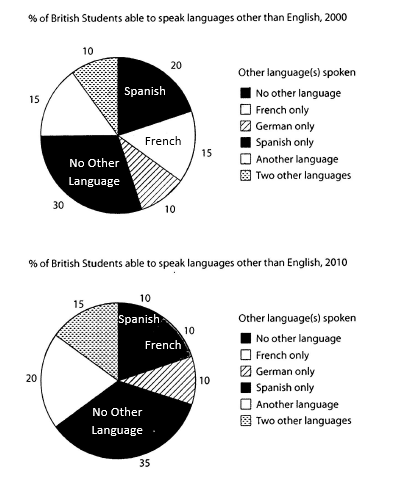
The charts below show the proportions of British students at one university in England who were able to speak other languages in addition to English, in 2000 and 2010
Summarise the information by selecting and reporting the main features, and make comparisons where relevant.
Student answer (Band 5.0)
The charts below illustrate the percentage of British students at one university in England who were able to speak other languages in addition to English, in 2000 and 2010. It was explain the percentages of British students over the two different categories. Overall, the percentage of British students able to speak languages other than English,2000. No other language was the highest ratio in this pie chart, whereas two other languages was the lowest proportion in this chart.In 2010, no other language was the upward trend in this figure, whereas these three languages remain stable.
AI examiner evaluation
| Criterion | Band |
|---|---|
| Task Achievement / Task Response | 4.0 |
| Coherence and Cohesion | 5.0 |
| Lexical Resource | 5.5 |
| Grammatical Range and Accuracy | 5.0 |
| Overall | 5.0 |
Task Achievement / Task Response: Band 4.0
The response identifies a relevant feature of the 2000 chart: “No other language” had the largest share, while “two other languages” had the smallest. However, it gives almost no accurate comparison of the two years. In 2010, “no other language” rose from 30% to 35%, but this is described vaguely as an “upward trend”; the claim that “these three languages remain stable” is unclear and inaccurate, since only German stayed at 10%, while French and Spanish both fell. The response also omits the increases in “another language” and “two other languages.” The task requires at least 150 words, but this response has 71 words, 79 short; 23 copied words from the prompt were not counted. Include a clear overview and select key figures to support it.
Coherence and Cohesion: Band 5.0
There is a basic attempt to organise the response: an opening sentence is followed by a paragraph beginning “Overall,” and the contrast marker “whereas” helps signal comparisons. However, the ideas do not progress clearly from an overview to specific comparisons, and the second paragraph combines both years without explaining the relationships between the figures. Punctuation and spacing also make the text harder to follow, as in “English,2000” and “chart.In 2010.” The reference “these three languages” is not clear enough for the reader to identify which categories are meant. A more coherent structure would use a brief introduction, a precise overview, and a separate comparison of the main changes, with clear references to each language category.
Lexical Resource: Band 5.5
The response uses some task-relevant vocabulary, including “percentage,” “proportion,” “highest,” and “lowest,” and it attempts to describe change with “upward trend” and “remain stable.” This gives it enough basic language to communicate a few chart features. However, several expressions are imprecise or unnatural: “It was explain the percentages” does not clearly describe the charts, and “no other language was the highest ratio” is an awkward way to report a category’s share. “These three languages” is also too vague for accurate reporting. Use standard chart language such as “accounted for,” “increased,” “declined,” and “remained unchanged,” and name the categories directly. This would make the limited comparisons clearer and more appropriate to an academic report.
Grammatical Range and Accuracy: Band 5.0
The response attempts a few sentence patterns, including a relative clause in “students … who were able to speak” and a contrast structure using “whereas.” These show some effort to go beyond isolated simple statements. However, the range remains limited, and errors occur in basic sentence construction. “It was explain the percentages” has an incorrect verb form and does not form a grammatical sentence; “no other language was the upward trend” also uses an unsuitable structure for describing a change. The sentence beginning “Overall, the percentage …, 2000” is incomplete, and punctuation is inconsistent, with missing spaces after commas and full stops. Practise complete sentences with accurate past-tense verbs, for example, “The proportion with no other language increased from 30% to 35%.”
See this exact question answered at other band scores. The same prompt compared across bands.
Browse more IELTS Writing model answers or get your own writing scored by the same AI examiner.