Band 5.0 IELTS Writing Task 1 Model Answer
Overall Band Score: 5.0 · Cambridge IELTS 11 · 2026-11-06
IELTS Writing Task 1 question
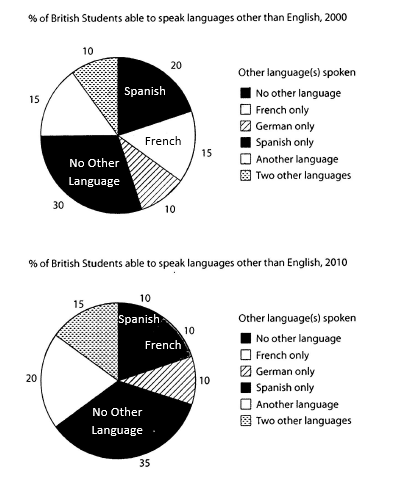
The charts below show the proportions of British students at one university in England who were able to speak other languages in addition to English, in 2000 and 2010
Summarise the information by selecting and reporting the main features, and make comparisons where relevant.
Student answer (Band 5.0)
In 2000 20 percent of the student studing at one university in English was able to speak Spanish but in 2010 this numbers become significantly low and comes at 10 percent and in the case of french in 2000 the ratio is at fifteen per hundred but in 2010 it also decrease but not so much as that of Spanish the decrease in French is about five percent .It is interesting that the ratio of students who speaks German remain same .The shocking thing is that the ratio of those students who speaks other two languages increase . The ratio of students who speak another language increase by five percent .The bad thing is that the ratio of those students increase who did not speak any other language.
From this chart I can easily said that from the passage of time the people changes her mind to learn different language
AI examiner evaluation
| Criterion | Band |
|---|---|
| Task Achievement / Task Response | 5.5 |
| Coherence and Cohesion | 5.0 |
| Lexical Resource | 5.0 |
| Grammatical Range and Accuracy | 5.0 |
| Overall | 5.0 |
Task Achievement / Task Response: Band 5.5
You report several accurate comparisons: Spanish falls from 20% to 10%, French from 15% to 10%, German remains at 10%, and the shares for another language and two other languages rise. You also note that the proportion speaking no other language increases. However, the response has no clear, neutral overview of the main pattern; instead, it calls changes “shocking” or “bad” and ends with a broad claim that people changed their minds, which the charts do not establish. Some categories are not clearly distinguished, and the largest group in both years—students speaking no other language—is not presented as a central feature. A concise overview and more objective, complete comparisons would make the report more fully address the task.
Coherence and Cohesion: Band 5.0
The response follows a broadly chronological order, moving from 2000 figures to changes in 2010, and uses basic links such as “but,” “also,” and “in the case of.” This gives the reader some sense of comparison. However, the information is presented as one long paragraph, with no clear overview or grouping of related trends. Repeated openings such as “the ratio” and “the shocking thing” make the progression feel list-like, while the final sentence shifts to an unsupported generalisation rather than summarising the data. Organise the report into an overview and focused detail paragraphs, and use clear references to the categories so each comparison connects smoothly to the next.
Lexical Resource: Band 5.0
You use enough topic vocabulary to identify the main categories, including “Spanish,” “French,” “German,” and “another language,” and you attempt comparison language such as “decrease” and “increase.” However, the range is limited and several expressions are inaccurate or unnatural, including “the ratio … is at fifteen per hundred,” “this numbers become significantly low,” and “speak other two languages.” Repeated use of “ratio” also makes the description less precise; “proportion” or “percentage” is more suitable for chart data. Evaluative phrases such as “the bad thing” are not appropriate for an objective report. Aim for precise, neutral collocations such as “the proportion rose” and “the share speaking no other language.”
Grammatical Range and Accuracy: Band 5.0
The response attempts to connect comparisons in longer sentences, for example by contrasting 2000 and 2010 with “but,” and the main trends can generally be understood. However, the range is limited, and errors recur in verb forms, agreement, articles, and sentence boundaries. Examples include “the student studing … was able,” “this numbers become,” “students who speaks,” and “I can easily said.” The final sentence also has faulty agreement and pronoun use: “the people changes her mind.” Several clauses are joined with full stops missing or inconsistent punctuation, making the opening difficult to follow. Practise accurate simple comparison sentences first, then combine them with controlled clauses using “while” or “whereas.”
See this exact question answered at other band scores. The same prompt compared across bands.
Browse more IELTS Writing model answers or get your own writing scored by the same AI examiner.