Band 5.0 IELTS Writing Task 1 Model Answer
Overall Band Score: 5.0 · Cambridge IELTS 11 · 2026-11-06
IELTS Writing Task 1 question
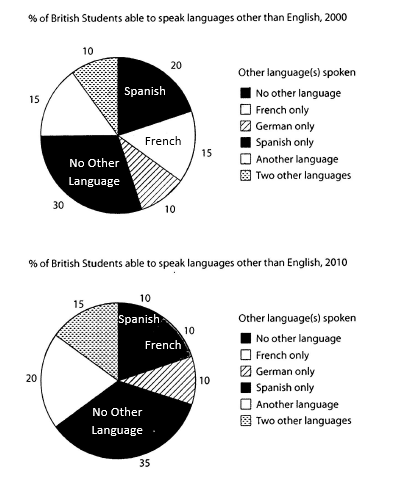
The charts below show the proportions of British students at one university in England who were able to speak other languages in addition to English, in 2000 and 2010
Summarise the information by selecting and reporting the main features, and make comparisons where relevant.
Student answer (Band 5.0)
The pie charts illustrates the figuire of British students who are able to speak other languages addition to English at one university located i England, in 2000 and 2010.
Overall , it is clear that in both years no other language accounted the largest proportion, while German olny recorded the smallest figure.
In 2000, No other language represents the largest share of total, at 30%, while in 2010 it increased by only 5%. German only remained unchanged in both years. Spanish figure fell down by 10%, 20% to 10% in 2010, while Two other language rose up by 5%, from 10% in 2000 and 15% in 2010.
Another language recorded 15% of total share in 2000, and
AI examiner evaluation
| Criterion | Band |
|---|---|
| Task Achievement / Task Response | 4.5 |
| Coherence and Cohesion | 4.5 |
| Lexical Resource | 5.5 |
| Grammatical Range and Accuracy | 5.0 |
| Overall | 5.0 |
Task Achievement / Task Response: Band 4.5
You identify the main overall feature—that “No other language” was the largest category in both years—and report several relevant changes, including Spanish falling from 20% to 10% and “Two other languages” rising from 10% to 15%. However, the response is incomplete: it ends mid-sentence after “Another language recorded 15% of total share in 2000, and”, so the 2010 figure and the French data are not reported. The claim that German was the smallest category is also inaccurate: it was tied with “Two other languages” in 2000 and with French in 2010. The response is 33 words below the required minimum, which contributes to the limited coverage. Include a complete comparison of the main categories and check the ranking of the figures.
Coherence and Cohesion: Band 4.5
There is a basic structure, with an introduction, an overview and a paragraph describing selected figures. The sequence from the overall pattern to year-by-year comparisons is generally understandable, and “while” and “from … to …” help connect contrasts. However, the final sentence is unfinished, leaving the discussion of “Another language” without a comparison and making the response feel abruptly cut off. Some links are also awkward or repetitive, such as “while” being used repeatedly to join different comparisons. Organise the details into complete comparisons—for example, group categories that rose, fell or stayed stable—and finish each paragraph with a complete idea. This would make the progression clearer and the cohesion less mechanical.
Lexical Resource: Band 5.5
You use some relevant chart vocabulary, including “proportion,” “largest share,” “accounted” and “remained unchanged,” which helps convey the data. There is also some variation in how changes are described. However, several spelling errors and imprecise or unnatural phrases reduce control: “figuire,” “olny,” “located i England,” “fell down” and “rose up.” “The pie charts illustrates” also reflects a word-form issue, while “figure” is repeated where more precise terms such as “percentage” or “proportion” would fit. Aim for accurate, conventional language for describing charts, and proofread spelling carefully. A broader set of precise verbs and nouns would help you report changes more naturally without relying on repeated wording.
Grammatical Range and Accuracy: Band 5.0
The response attempts a mixture of simple statements and longer comparisons, including “while German only recorded…” and the sentence comparing Spanish and the two-language category. The main figures are usually understandable despite grammatical problems. Errors are frequent, however, and some sentences are incomplete or awkwardly formed. For example, “The pie charts illustrates” has subject–verb disagreement, and “No other language represents” shifts into the present tense when describing past data. The final clause beginning “Another language recorded…” has no completed comparison, so it is a fragment. There are also problems with articles and sentence construction in “at 30%, while in 2010 it increased by only 5%.” Practise consistent past-tense reporting and check agreement and sentence completeness.
See this exact question answered at other band scores. The same prompt compared across bands.
Browse more IELTS Writing model answers or get your own writing scored by the same AI examiner.