Band 5.5 IELTS Writing Task 1 Model Answer
Overall Band Score: 5.5 · Cambridge IELTS 11 · 2026-11-06
IELTS Writing Task 1 question
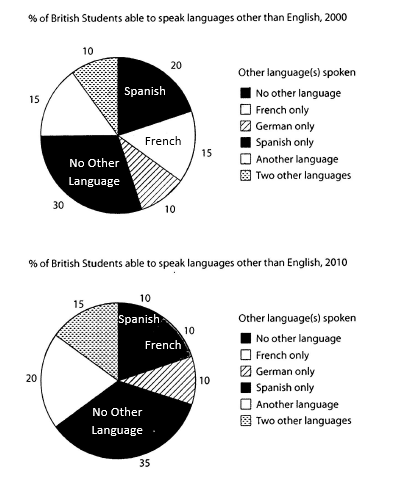
The charts below show the proportions of British students at one university in England who were able to speak other languages in addition to English, in 2000 and 2010
Summarise the information by selecting and reporting the main features, and make comparisons where relevant.
Student answer (Band 5.5)
THW PIES CHARTS ILLUSTRATES THE PERCENTAGES OF BRITISH STUDENTS AT ONE UNIVERSITY IN ENGLAND WHO WERE CAPABLE TO TALK IN OTHER FOREIGN LANGUAGES IN ADDITION TO ENGLISH , IN TWO DIFFRENT YEARS 2000 AND 2010.
OVERALL, WE SEE THAT THERE IS A VARIATION ON THE PROPORTIONS BETWEEN THE TWO YEARS, BUT THE NO OTHER LANGUAGE CATEGORY SHOWS THE HIGHEST PERCENTAGE IN BOTH YEARS.
FIRST OF ALL, IN 2000 THE STUDENTS WHO SPEAKS ENGLISH ONLY ARE THE HIGHEST PROPORTION WITH 30% , FOLLOWING BY THE SPANISH ONLY AT 20% , WHILE THE FRENCH ONLY AND ANOTHER LANGUAGE REPRESENT THE SAME LEVEL AT 15% , IN A SIMILER SITUATION TO GERMAN ONLY AND TWO OTHER LANGUAGES AT 10%.
MEANWHILE IN 2010, THE NO OTHER LANGUAGE STAYED IN ITS POSITON BEYING THE HIGHEST AND INCREASING BY 5% (35%) COMPARING TO 2000 , MOREOVER THE SAME RISE LEVEL HAPPEND TO ANOTHER LANGUAGE AND TWO OTHER LANGUAGES
TO REACH 20% AND 15% , RESPECTEVELY. WHILE THE SPANISH ONLY CATEGORY SHOWS A MASSIVE DECREASE TO JUST 10% , THE SAME LEVEL WITH FRENCH ONLY WHICH DECREASED BY 5%. HOWEVER THE GERMAN ONLY STAYED IN THE SAME PERCENTAGE IN THE BOTH YEARS FOR 10 %
AI examiner evaluation
| Criterion | Band |
|---|---|
| Task Achievement / Task Response | 6.0 |
| Coherence and Cohesion | 6.0 |
| Lexical Resource | 5.5 |
| Grammatical Range and Accuracy | 5.0 |
| Overall | 5.5 |
Task Achievement / Task Response: Band 6.0
You identify the main overall feature accurately: “No other language” is the largest category in both years, rising from 30% to 35%. You also report the key changes for Spanish, French, “Another language” and “Two other languages,” and correctly note that German remains at 10%. This covers the main comparisons, although some details are less fully expressed: the opening says there is “a variation” without specifying the overall shift, and the 2000 description calls the 30% group students who “speak English only,” rather than students with no other language. Make the overview more precise by summarising the rise in the no-other-language and multiple/other-language categories alongside the falls in Spanish and French. The figures themselves are generally accurate and relevant.
Coherence and Cohesion: Band 6.0
The response has a clear overall arrangement: an introduction, an overview, then a paragraph for each year. This makes the comparison easy to follow, and signposts such as “Overall,” “First of all” and “Meanwhile” help indicate progression. However, some linking is mechanical or unclear. The final paragraph strings several changes together with “moreover,” “while” and “however,” and the sentence beginning “Moreover the same rise level…” lacks a clear connection to the preceding point. The overview also repeats the idea that the no-other-language category is highest without giving a broader summary of the changes. Use more direct comparisons between years and divide the final sequence into clearer sentences; this would make cohesion more natural and references easier to track.
Lexical Resource: Band 5.5
You use relevant chart vocabulary, including “proportions,” “percentage,” “category,” “increasing” and “decrease,” and you attempt to describe changes rather than simply list figures. However, spelling and word-choice errors are noticeable and sometimes make the phrasing awkward: “pies charts,” “diffretent,” “similer,” “positon” and “respectevely” are examples. Some expressions are also imprecise, such as “variation on the proportions” and “same rise level”; “students who speaks English only” does not accurately name the chart category. Aim for standard chart collocations and accurate category labels, and proofread spelling. A more controlled vocabulary would make the comparisons clearer and more natural.
Grammatical Range and Accuracy: Band 5.0
You attempt a mix of sentence forms, including comparisons and clauses introduced by “while” and “however,” and the main trends can generally be understood. Some grammatical errors remain, particularly with subject–verb agreement and sentence construction: “the students who speaks” should use a plural verb, while “the no other language stayed” treats a category as if it were a person or group. The final section also contains a fragment beginning “While the Spanish only category…” and several clauses joined into a long sentence, which weakens punctuation and control. Articles and prepositions are sometimes awkward, as in “in the both years.” Build shorter, complete sentences around each comparison, check agreement, and use subordinate clauses only when they are attached to a main clause.
See this exact question answered at other band scores. The same prompt compared across bands.
Browse more IELTS Writing model answers or get your own writing scored by the same AI examiner.