Band 6.5 IELTS Writing Task 1 Model Answer
Overall Band Score: 6.5 · Cambridge IELTS 11 · 2026-11-06
IELTS Writing Task 1 question
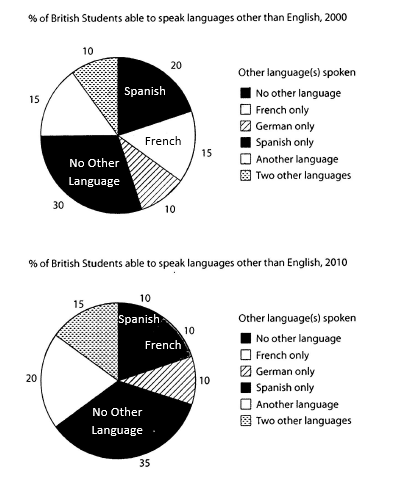
The charts below show the proportions of British students at one university in England who were able to speak other languages in addition to English, in 2000 and 2010
Summarise the information by selecting and reporting the main features, and make comparisons where relevant.
Student answer (Band 6.5)
The pie charts illustrate the percentage of students of a university in Britain who were comfortable to communicate in other langauges besides English, between 2000 and 2010.
Overall, it is evident that most of the students are not able to communicate in any other language other than English in both years. Spanish and French went from dominating language to relativley lower postion while percentage of students who speak another unnamed language and two other languages increased over the span of time.
Looking at the piecharts more closely, it can be seen that British students who cannot speak any other language besides English accounted for a dominant percentage which was around 30% and 35% in respective years while the proportion of German speakers remain unchanged in both years with around 10%.
Turning to the rest of the categories, it is clear that the proportion of British students who speak Spanish and French declined from 20% and 15%, repectively to both 10% in 2010. By contrast, the percentage two other language speakers increased by time from 10% to 15% and that of similarly went up for speakers of another language from 15% to 20% in 2010.
AI examiner evaluation
| Criterion | Band |
|---|---|
| Task Achievement / Task Response | 7.5 |
| Coherence and Cohesion | 7.0 |
| Lexical Resource | 6.0 |
| Grammatical Range and Accuracy | 6.0 |
| Overall | 6.5 |
Task Achievement / Task Response: Band 7.5
The response selects the main comparisons accurately and gives a clear overview: the share with no additional language rises from 30% to 35%, Spanish and French decline, and the “another language” and “two other languages” groups grow. It also reports the unchanged German figure. These details address the task well and are supported with relevant data. The overview’s claim that most students could not speak another language is slightly over-generalised: this category is the largest single group, but it represents only 30% and 35%, not a majority. Also, “Spanish and French went from dominating language” is imprecise because Spanish is the largest language category in 2000, while French is not. More precise wording would make the overview fully reliable and nuanced.
Coherence and Cohesion: Band 7.0
The response is organised into a clear introduction, overview and two detail paragraphs. Its progression from the overall pattern to the unchanged and declining categories, then to the increasing categories, is easy to follow. Linking phrases such as “Overall,” “Looking at the pie charts more closely,” and “By contrast” help signal these stages. Cohesion is generally effective, though some connections are awkward or repetitive: “while percentage of students” lacks a clear article, and “and that of similarly went up” makes the relationship between the two rising groups difficult to process. Use concise parallel structures, for example, “Both groups increased: the first from 10% to 15%, and the second from 15% to 20%.”
Lexical Resource: Band 6.0
There is adequate vocabulary for describing the charts, including “accounted for,” “proportion,” “declined,” and “increased,” and the meaning remains clear. The writer also attempts more varied phrasing, but several choices are inaccurate or unnatural: students are described as “comfortable to communicate,” and “went from dominating language to relativley lower postion” is an awkward way to describe the changes. Spelling slips such as “langauges,” “relativley,” “repectively,” and “piecharts” also reduce control. Aim for precise chart language and check spelling; terms such as “share,” “category,” and “fell” can describe the data naturally without overcomplicating the sentence.
Grammatical Range and Accuracy: Band 6.0
The response uses a mix of simple and complex forms, including a subordinate clause in “while the proportion of German speakers remain unchanged” and a contrast structure beginning “By contrast.” Most relationships between figures are understandable, but some grammatical errors remain. For example, “the proportion … remain unchanged” needs subject–verb agreement (“remains”), and “while percentage of students” needs an article (“while the percentage”). The phrase “the percentage two other language speakers” is missing “of,” while “that of similarly went up” is not a complete, well-formed parallel construction. There is also a tense inconsistency between the past data and “are not able.” More consistent past-tense reporting and carefully checked sentence patterns would improve accuracy.
See this exact question answered at other band scores. The same prompt compared across bands.
Browse more IELTS Writing model answers or get your own writing scored by the same AI examiner.