Band 5.5 IELTS Writing Task 1 Model Answer
Overall Band Score: 5.5 · Cambridge IELTS 11 · 2026-11-08
IELTS Writing Task 1 question
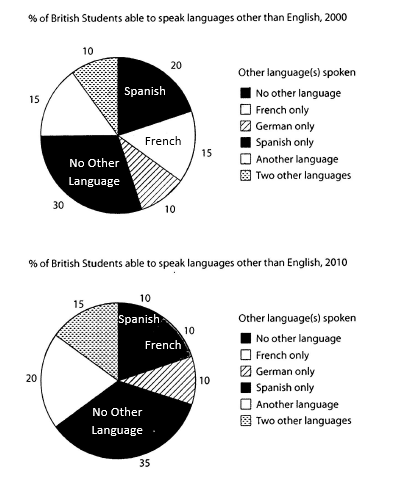
The charts below show the proportions of British students at one university in England who were able to speak other languages in addition to English, in 2000 and 2010
Summarise the information by selecting and reporting the main features, and make comparisons where relevant.
Student answer (Band 5.5)
The pie charts show the ratio of British students at university of england who speaks other languages in addition to english in about one decade (2000 and 2010).
Overall, the chart illustrates that spanish, french speakers are decresed where two other language and no other langue speakers are increased where the german languagwe speakers remains the same in 2000 and 2010 respectively.
The spanish and french speakers decreased from 20% and 15% to 10% each where the german speakers remains the same in whole deuration of 10 years.
On the other hand the no other language , another language and two other language speakers are rises up from 30%, 15% and 10% to 35%,, 20% and 15% respectively in 2000 and 2010.
AI examiner evaluation
| Criterion | Band |
|---|---|
| Task Achievement / Task Response | 6.0 |
| Coherence and Cohesion | 6.0 |
| Lexical Resource | 5.0 |
| Grammatical Range and Accuracy | 5.0 |
| Overall | 5.5 |
Task Achievement / Task Response: Band 6.0
You identify the main changes accurately: Spanish and French fell, German stayed unchanged, while the no-other-language, another-language and two-other-languages categories rose. The figures you give match the charts, and your overview captures the broad contrast between the declining and increasing groups. However, the report is brief and the comparisons are not developed much beyond listing the start and end values; it would be stronger with clearer coverage of the largest category in each year and a more precise description of the overall distribution. The response also falls 28 words short of the required minimum, which limits the detail available to summarise the charts fully. Add a little more comparison rather than repeating the same trends.
Coherence and Cohesion: Band 6.0
The response has a recognisable structure: an introduction, an overview, and two paragraphs grouping categories by whether they rose or fell. This gives the reader a coherent overall route through the information. Linking expressions such as “Overall” and “On the other hand” help signal the purpose of each section. Some connections are less clear, however: the repeated use of “where” does not express the intended contrast naturally, and the final sentence packs three categories and six figures into one long sequence. Use clearer links such as “while” or “by contrast,” and separate the comparisons into more manageable sentences. This would make the progression easier to follow without changing the useful grouping you have established.
Lexical Resource: Band 5.0
You use relevant chart vocabulary, including “decreased,” “remains the same,” and “increased,” and the reader can generally understand which categories you are comparing. However, the range is limited and several word choices or forms are inaccurate, such as “ratio” for the proportions shown, “speakers” for the student categories, and “rises up” for a past change. There are also noticeable spelling errors, including “decresed,” “langue,” “languagwe,” and “deuration.” These reduce the precision and polish of the report, even though the intended meaning is usually recoverable. Build a small set of accurate terms for describing proportions and changes, and check spelling and word forms carefully.
Grammatical Range and Accuracy: Band 5.0
You attempt both simple statements and longer comparisons, and the main trends remain understandable. Some grammatical errors are evident, particularly in subject–verb agreement and tense: “students … who speaks” should use a plural verb, while “the german speakers remains” should be “the German category remained.” The phrase “are rises up” also combines incompatible verb forms. Articles and sentence construction need attention in “at university of england,” and the final sentence has awkward punctuation, including a doubled comma after “35%.” Practise forming past-tense comparison sentences with a clear subject and verb, for example, “The proportion with no other language rose from 30% to 35%.”
See this exact question answered at other band scores. The same prompt compared across bands.
Browse more IELTS Writing model answers or get your own writing scored by the same AI examiner.