Band 6.0 IELTS Writing Task 1 Model Answer
Overall Band Score: 6.0 · Cambridge IELTS 11 · 2026-11-09
IELTS Writing Task 1 question
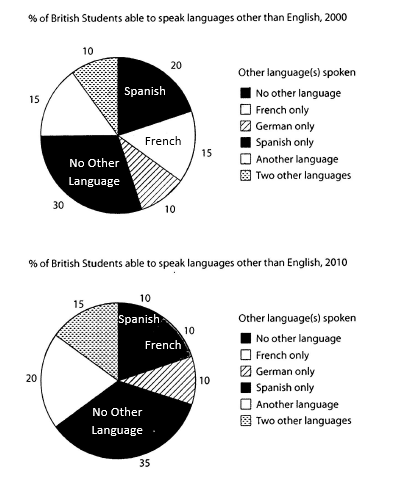
The charts below show the proportions of British students at one university in England who were able to speak other languages in addition to English, in 2000 and 2010
Summarise the information by selecting and reporting the main features, and make comparisons where relevant.
Student answer (Band 6.0)
The charts vividly compare the percentages of British students who were capable of communicating in other languages except English at a British university between the years:2000 and 2010.
Overall, there are significant amount of students who are capable of speaking in Spanish, French and German in addition to Engish in this British university. Although, the percentages decreased for Spanish and French in the time range mentioned. However, there is a slight increase in bilingual students speaking in another language outside these aforementioned ones. Also people speaking in two other languages has also increased.
In 2000, the percentages of students of this particular university speaking in Spanish was 20%. In 2010, the percentage became 10%. Similarly, the percentage of French bilingual students became 10% from 20% also. However, the percentage remain same for German bilinguals, which is 10%.
To talk about other language speakers, the percentage of students speaking in another language other than Spanish, French and German outside of English was 15% in 2000. The percentage increased to 20% in 2010. Similarly, in 2000 the students speaking in two other languages was 10% and the percentage increased to 15% in 2010. However, the charts show that the percentage of non capable students rose from 30% to 35% during the time range.
AI examiner evaluation
| Criterion | Band |
|---|---|
| Task Achievement / Task Response | 6.5 |
| Coherence and Cohesion | 6.5 |
| Lexical Resource | 5.5 |
| Grammatical Range and Accuracy | 5.5 |
| Overall | 6.0 |
Task Achievement / Task Response: Band 6.5
You identify the main overall changes: Spanish and French declined, while the shares for another language, two other languages, and no other language increased; German remained unchanged. The response also includes relevant figures for most categories. However, one key comparison is inaccurate: French was 15% in 2000, not 20%, so the fall to 10% is smaller than stated. The overview’s claim that there are “significant amount” of students speaking Spanish, French and German is also imprecise, particularly because the no-other-language group is the largest in both years. To strengthen the report, make the overview more selective and accurate, and describe the largest category and the contrasting movements clearly.
Coherence and Cohesion: Band 6.5
The response has a clear overall structure, moving from an introduction and overview to paragraphs covering the language categories. This makes the information easy to follow, and comparisons such as the rise from 15% to 20% for another language are placed logically. However, some linking is mechanical or awkward: “Although” and “However” are used close together in the overview, and “Similarly” introduces changes that are not quite parallel. The final paragraph also groups several categories without a clear hierarchy. Use fewer, more precise transitions and organise the details around the main contrasts—for example, declining categories first, then unchanged and increasing categories—to create smoother progression.
Lexical Resource: Band 5.5
You use a reasonable range of task-related vocabulary, including “percentages,” “bilingual,” “increased,” and “remained same,” and the meaning is generally understandable. However, several expressions are imprecise or unnatural for describing chart data. “Non capable students” incorrectly suggests an inability, while “outside of English” and “other languages except English” are cumbersome. There are also spelling and word-form slips, including “Engish” and “significant amount.” Repeated use of “percentage of students” limits flexibility. Aim for concise, accurate chart language and collocations, such as “students who spoke no other language” and “the proportion of students speaking French.”
Grammatical Range and Accuracy: Band 5.5
You attempt a mix of simple and complex sentences, including contrast clauses and comparisons, and the main message remains understandable. Some grammatical errors nevertheless recur. For example, “there are significant amount” has an agreement and article problem, while “the percentage remain same” needs a past-tense verb and an article. In “the percentage of French bilingual students became 10% from 20% also,” the comparison is awkwardly constructed, and “Although” is used as a sentence connector without a complete contrasting clause. Punctuation is also inconsistent, as in “between the years:2000 and 2010.” Check subject–verb agreement, tense consistency, and clause boundaries, then use straightforward comparison structures accurately.
See this exact question answered at other band scores. The same prompt compared across bands.
Browse more IELTS Writing model answers or get your own writing scored by the same AI examiner.