Band 5.0 IELTS Writing Task 1 Model Answer
Overall Band Score: 5.0 · Cambridge IELTS 11 · 2026-11-09
IELTS Writing Task 1 question
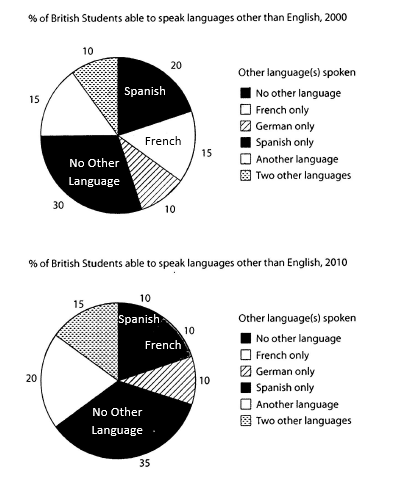
The charts below show the proportions of British students at one university in England who were able to speak other languages in addition to English, in 2000 and 2010
Summarise the information by selecting and reporting the main features, and make comparisons where relevant.
Student answer (Band 5.0)
The two charts illustrate the proportions of British students at one university in England who were able to speak other languages in addition to English, in 2000 and 2010.
Overall, it is clear that prior to no other language have the biggest share, while the figure second postion come Spanish which have fewest share. Whereas, in the both years Germany remain constant.
To commence, in 2000 the british pupils speak majority of no other language accounted for 30%. Moreover, the Spanish which came at second number were speaking approximately 20%. In addition, the French and Another language remain stable at 15%, while the Two other language and German decline 5% compare to French and Another language.
On the other hand, in 2010 the british youngster will have been speaking more no other language will rising from 30% to 35%. Furthermore, the Spanish, French and German come at the one line ratio will account 10%. Nevertheless, the Two other language drop 5% vis-a-vis to in 2000. Similarly, Another language growing extra 5% from 15% to 20%.
AI examiner evaluation
| Criterion | Band |
|---|---|
| Task Achievement / Task Response | 5.0 |
| Coherence and Cohesion | 5.5 |
| Lexical Resource | 5.0 |
| Grammatical Range and Accuracy | 5.0 |
| Overall | 5.0 |
Task Achievement / Task Response: Band 5.0
You identify the two years and report several relevant figures, including the rise in “No other language” from 30% to 35% and the increase in “Another language” from 15% to 20%. However, the overview is unclear and partly inaccurate: “Spanish … have fewest share” does not describe the charts, since Spanish is the largest additional-language category in 2000, while German is the smallest alongside two other languages. The claim that French and “Another language” remain stable also overlooks that French falls from 15% to 10%. Some comparisons are difficult to interpret, such as saying two categories “decline 5% compare to” others. State the main shifts accurately in the overview, then support them with clear, correctly expressed comparisons.
Coherence and Cohesion: Band 5.5
The response has a recognisable structure: an introduction, an overview, and separate paragraphs for 2000 and 2010. This gives the reader a basic route through the information. However, progression is weakened by unclear or mechanically linked statements. For example, “Whereas, in the both years Germany remain constant” is detached from the preceding overview, and “Nevertheless” does not express a clear contrast in the sentence about two other languages. The year-by-year paragraphs also list figures without consistently grouping the most important changes. Use a concise overview followed by comparisons organised around increases, decreases, and unchanged figures. Choose linking words for their precise logical function and make each sentence’s relationship to the previous one explicit.
Lexical Resource: Band 5.0
You use some task-relevant vocabulary, including “proportions,” “accounted for,” “remain constant,” and “growing,” and the reader can generally identify the categories being discussed. However, the range is limited and several word choices or collocations are inaccurate enough to make parts difficult to understand. Phrases such as “second number,” “one line ratio,” and “drop 5% vis-a-vis to in 2000” are not natural ways to describe chart data. There are also inconsistent labels such as “British pupils” and “British youngster,” where the chart refers to students. Aim for precise, repeated chart terminology and standard comparison phrases, such as “ranked second,” “stood at the same proportion,” and “fell by five percentage points.”
Grammatical Range and Accuracy: Band 5.0
You attempt both simple and more complex sentences, including clauses introduced by “while” and “whereas,” but control is inconsistent. Errors in agreement and verb forms appear in “Germany remain constant” and “the Spanish … were speaking”; the latter also uses an unsuitable tense for describing chart data. The sentence “the British youngster will have been speaking more no other language will rising” contains several faulty verb forms and obscures the intended increase. Articles and sentence construction are also problematic in “in the both years.” These errors occur often enough to make some comparisons hard to follow. Practise accurate past-tense reporting and simple comparison structures before adding subordinate clauses, and check subject–verb agreement and sentence boundaries.
See this exact question answered at other band scores. The same prompt compared across bands.
Browse more IELTS Writing model answers or get your own writing scored by the same AI examiner.