Band 5.0 IELTS Writing Task 1 Model Answer
Overall Band Score: 5.0 · Cambridge IELTS 11 · 2026-11-10
IELTS Writing Task 1 question
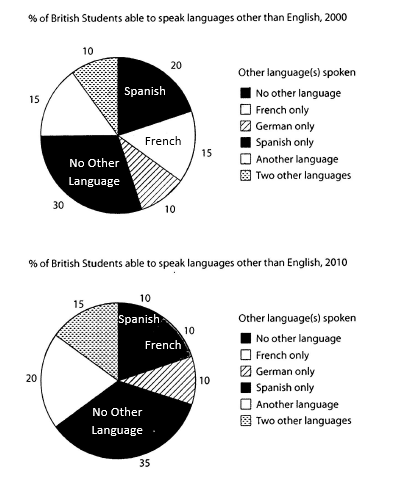
The charts below show the proportions of British students at one university in England who were able to speak other languages in addition to English, in 2000 and 2010
Summarise the information by selecting and reporting the main features, and make comparisons where relevant.
Student answer (Band 5.0)
The chart illustrates proportion of British students which speaks different languages as well as english in year 2000 And 2007
In average number of student speaking english is significantly higher than other languages , Spanish is more in number as compared to other language,
there are students who can speak two other languages ,however there is no significant changes in number between year.
Proportions of german language remains the same in both the year that is 10
Moreover Spanish and French are popular among students as their percentages are higher ,apparently throughout the year their percentage is slightly lower than year 2000.
If we compare both data ,highest spoken language is English and second to that id spanish and french respectively.
AI examiner evaluation
| Criterion | Band |
|---|---|
| Task Achievement / Task Response | 4.5 |
| Coherence and Cohesion | 4.5 |
| Lexical Resource | 5.0 |
| Grammatical Range and Accuracy | 5.0 |
| Overall | 5.0 |
Task Achievement / Task Response: Band 4.5
The response identifies some relevant features, including the unchanged German figure and the rise in students speaking two other languages, but several key comparisons are inaccurate or unclear. The chart shows Spanish falling from 20% to 10% and French from 15% to 10%; describing them as “popular” because their percentages are “higher” does not explain this decline. The claim that English is the “highest spoken language” misreads the chart: it reports students with no other language, not English-speaking ability. The year is also given as 2007 rather than 2010. The response is under the required 150 words, and its overview and coverage of the main changes are limited. Report the chart categories and figures precisely, then summarise the overall shifts.
Coherence and Cohesion: Band 4.5
There is a basic attempt to organise the response, moving from a general statement to selected comparisons, and phrases such as “Moreover” and “If we compare both data” signal relationships. However, the progression is difficult to follow because the opening overview is unclear and the final comparison repeats or misstates earlier points. The ideas are not grouped into a clear overview followed by a systematic account of the two years. Some linking is also awkward: “however” does not clearly connect the claim about speaking two languages to the lack of change, and “In average” does not establish a meaningful comparison. Use separate paragraphs for the overview and key details, and connect each comparison directly to the relevant figures.
Lexical Resource: Band 5.0
The response uses a small set of relevant terms, including “proportion,” “percentages,” “remains the same,” and “compare,” so the topic is generally recognisable. However, the vocabulary is limited and several choices are imprecise or unnatural, which sometimes makes the intended meaning difficult to interpret. For example, “Spanish is more in number” and “highest spoken language” do not accurately describe the chart categories, while “popular” suggests preference rather than the proportion able to speak a language. “In average number” is also an unsuitable phrase for this comparison. Aim for precise chart language such as “accounted for,” “the proportion speaking,” and “increased/decreased from … to …”; distinguish “no other language” from English itself.
Grammatical Range and Accuracy: Band 5.0
The response communicates some basic comparisons through simple sentences, and the statement “Proportions of german language remains the same” conveys a recognisable idea. However, the range of sentence structures is limited, and recurring errors affect clarity. In the opening, “proportion … which speaks” has faulty agreement and an unsuitable relative construction; “in year 2000 And 2007” lacks appropriate articles and punctuation. The sentence beginning “there are students” shifts awkwardly into “however there is no significant changes,” where the verb does not agree with the plural noun. Capitalisation and sentence boundaries are also inconsistent. Practise accurate subject–verb agreement, articles with years, and controlled compound sentences, checking each sentence for a clear subject and verb.
See this exact question answered at other band scores. The same prompt compared across bands.
Browse more IELTS Writing model answers or get your own writing scored by the same AI examiner.