Band 5.0 IELTS Writing Task 1 Model Answer
Overall Band Score: 5.0 · Cambridge IELTS 11 · 2026-11-10
IELTS Writing Task 1 question
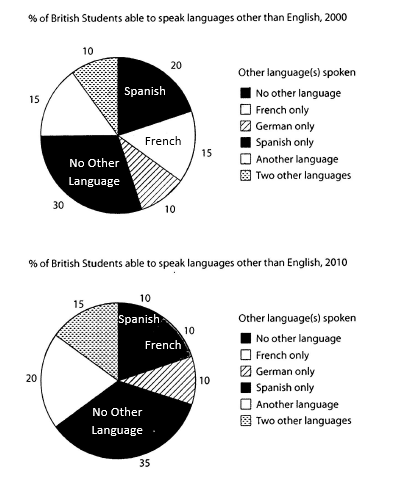
The charts below show the proportions of British students at one university in England who were able to speak other languages in addition to English, in 2000 and 2010
Summarise the information by selecting and reporting the main features, and make comparisons where relevant.
Student answer (Band 5.0)
The pie sharts illustrates the percentage of british students at a university in England who spoke other languages in addition to english from 2000 to 2010.
Overall, it is clearly seen that, a large number of british people not use any other language and in some area they also speak french and spanish.
In 2000, oly 20% students in a university spoke spanish and 30% spoke french while the exposure of other languages is jus 5% to 10 % and majority of students spoke their native lanuage 30%. And two other languages were also spoke but those are not famous.
On the other hand, in 2010, 35% students spoke english that is their mother tongue and 20% french is also common while 10% students use spanish and french.
In both charts, german language is not much famous and students spoke just 10%.
AI examiner evaluation
| Criterion | Band |
|---|---|
| Task Achievement / Task Response | 4.0 |
| Coherence and Cohesion | 5.5 |
| Lexical Resource | 5.0 |
| Grammatical Range and Accuracy | 5.0 |
| Overall | 5.0 |
Task Achievement / Task Response: Band 4.0
The response identifies the general topic and attempts comparisons between the two years, but it reports several key figures inaccurately, which limits how fully it addresses the task. In 2000, Spanish is given as 20%, but French is incorrectly reported as 30% rather than 15%; the 30% figure belongs to students speaking no other language. For 2010, the response says 20% spoke French, although the chart shows 10%, and it confuses English as a mother tongue with the category “no other language.” The overview is also vague and does not clearly summarise the main changes, such as the rise in no other language and the fall in Spanish. The response is 142 words, below the required 150. Report the categories and figures accurately, then highlight the main trends.
Coherence and Cohesion: Band 5.5
There is some organisation: the response has an opening, an overview, and separate paragraphs for 2000 and 2010, followed by a comparison of German. The time markers “In 2000” and “On the other hand, in 2010” help readers follow the basic sequence. However, progression is uneven because the overview is unclear and some details are grouped without a clear comparison. For example, “the exposure of other languages is jus 5% to 10%” does not specify which chart categories are being discussed, and “those are not famous” does not connect clearly to the data. Use one paragraph to summarise the main trends and organise the remaining details by comparable categories, with clear references to each year.
Lexical Resource: Band 5.0
The response uses a basic range of task-related vocabulary, including “percentage,” “spoke,” “majority,” and “mother tongue,” so the general subject is usually recognisable. However, vocabulary is repetitive and several choices are inaccurate or unnatural for describing chart data. “Exposure of other languages” does not clearly mean the proportions speaking those languages, while “not famous” is not an appropriate way to describe language prevalence. There are also noticeable spelling errors, including “sharts,” “british,” “oly,” “lanuage,” and “jus,” which reduce clarity and control. Choose precise chart language such as “accounted for,” “the proportion,” and “remained unchanged,” and proofread spelling and capitalisation.
Grammatical Range and Accuracy: Band 5.0
The response mainly relies on simple sentence patterns, with a few attempts to combine ideas using “while” and “and.” Some sentences communicate the intended meaning, but frequent errors in sentence construction and grammatical forms make parts difficult to interpret. For example, “a large number of british people not use any other language” is missing an auxiliary verb, and “two other languages were also spoke” uses an incorrect passive form. In “35% students spoke english,” the article is missing, while “20% french is also common” lacks a clear grammatical structure. Build accurate sentences such as “Thirty-five per cent spoke no other language” and “The proportion speaking French fell to 10%,” then check verb forms, articles, and punctuation.
See this exact question answered at other band scores. The same prompt compared across bands.
Browse more IELTS Writing model answers or get your own writing scored by the same AI examiner.