Band 5.5 IELTS Writing Task 1 Model Answer
Overall Band Score: 5.5 · Cambridge IELTS 11 · 2026-11-10
IELTS Writing Task 1 question
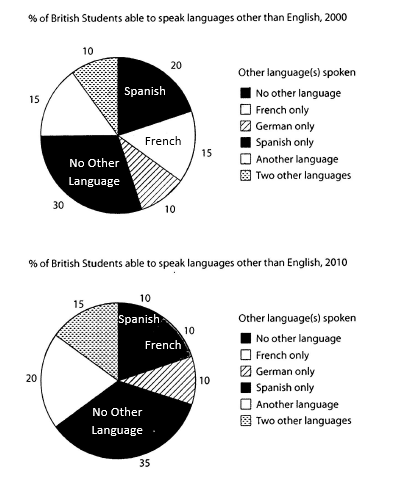
The charts below show the proportions of British students at one university in England who were able to speak other languages in addition to English, in 2000 and 2010
Summarise the information by selecting and reporting the main features, and make comparisons where relevant.
Student answer (Band 5.5)
The two pie chart illustrate the proportion of the British students who can speak other languages as well as English at one university in England in 2000 and 2010.
Overall, no other language accounted for the largest share at 30%, followed by Spanish language is spoken by 20% of British students in 2000. Furthermore, in 2010 it shows almost similar pattern as no other language received the largest proportion at 35%, which indicates that, most of the British students are not able to speak other languages except English.
Regarding no other language in 2000, it takes the biggest portion at 30%, furthermore, French and another language is spoken by 15% of students compared to that of Spanish is likely spoken by 20% students. Two other languages and German shows relatively small portion at 10%
In terms of no other language in 2010, it also represent the largest proportion at 35%, followed by another language and two other language is used by 20% and 15% of students, whereas, Spanish, French and German language is chosen by only 10% of British students.
overall, majority of the students in England are not able to speak other languages except English, however some students managed to followed other languages.
AI examiner evaluation
| Criterion | Band |
|---|---|
| Task Achievement / Task Response | 5.5 |
| Coherence and Cohesion | 5.5 |
| Lexical Resource | 5.5 |
| Grammatical Range and Accuracy | 5.0 |
| Overall | 5.5 |
Task Achievement / Task Response: Band 5.5
You identify the main overall feature in both years: students speaking no other language form the largest group, rising from 30% to 35%. You also report several relevant figures accurately, including Spanish at 20% in 2000 and the 2010 shares for another language and two other languages. However, the overview is partly repetitive, and the final claim that the “majority” could not speak another language is inaccurate: this group is 30% and 35%, not more than half. Some comparisons are listed rather than highlighted, and the distinction between speaking one named language and speaking two other languages could be clearer. A more precise overview should summarise the rise in the no-other-language and other-language categories, alongside the falls in Spanish and French.
Coherence and Cohesion: Band 5.5
The response has a recognisable structure, moving from an introduction and overview to details for 2000 and 2010. This helps the reader locate the information. However, progression is weakened by repeating the largest category in both the overview and the body, then repeating the general conclusion at the end. Linking words such as “Furthermore” and “whereas” are used, but some connections are awkward or inaccurate, and several sentences combine multiple figures without a clear comparison. For example, the 2000 sentence beginning “Regarding no other language” shifts quickly among French, another language, Spanish, and the smaller categories. Organise the body around changes between years or group similar categories, and use referencing and transitions more selectively.
Lexical Resource: Band 5.5
You use relevant chart vocabulary, including “proportion,” “largest share,” “accounted for,” and “followed by,” so the topic is generally clear. There is also some attempt to vary expressions for describing figures. However, several word choices and collocations are unnatural or imprecise, such as “received the largest proportion,” “shows relatively small portion,” and “managed to followed other languages.” Repetition of “language” and “students” also limits flexibility, while “chosen” suggests a choice rather than a reported ability. Use standard data-reporting phrases consistently, such as “accounted for,” “stood at,” and “the proportion speaking.” More precise vocabulary would make comparisons clearer and reduce awkward phrasing.
Grammatical Range and Accuracy: Band 5.0
You attempt both simple and longer sentences, including clauses linked with “whereas” and “which indicates,” but control is uneven. Errors in agreement and verb forms recur: “The two pie chart illustrate,” “French and another language is spoken,” and “it also represent” should use plural or singular forms consistently. The sentence “followed by Spanish language is spoken” joins clauses incorrectly, and “managed to followed” has an incorrect verb pattern. Articles and punctuation are also inconsistent, particularly around introductory phrases and commas. These errors sometimes make relationships between figures harder to follow. Practise accurate subject–verb agreement and build complex sentences with clear clause boundaries; shorter, controlled comparisons would improve reliability.
See this exact question answered at other band scores. The same prompt compared across bands.
Browse more IELTS Writing model answers or get your own writing scored by the same AI examiner.