Band 4.5 IELTS Writing Task 1 Model Answer
Overall Band Score: 4.5 · Cambridge IELTS 11 · 2026-11-10
IELTS Writing Task 1 question
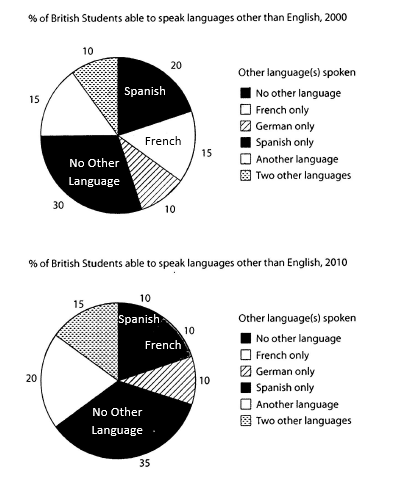
The charts below show the proportions of British students at one university in England who were able to speak other languages in addition to English, in 2000 and 2010
Summarise the information by selecting and reporting the main features, and make comparisons where relevant.
Student answer (Band 4.5)
The two pie charts illustrate how british students speak other languages in addition to English in England, in 2000 and 2010.
Overall, in 2000 and 2010, No other language was the most spoken language in England, while German was same in both years.
In 2000, 30% British students spoke No other language, which was the most dominant language, followed by French and Another language which accounted for 15% each. German and other two other languages spoked 10%. Spanish was common with 20% students.
In 2010, proprtions of the student who spoke no other language rose to 3
AI examiner evaluation
| Criterion | Band |
|---|---|
| Task Achievement / Task Response | 3.5 |
| Coherence and Cohesion | 5.0 |
| Lexical Resource | 5.0 |
| Grammatical Range and Accuracy | 5.0 |
| Overall | 4.5 |
Task Achievement / Task Response: Band 3.5
You identify the two years and report several figures from 2000 accurately, including 30% with no other language, 15% for French and another language, and 20% for Spanish. However, the response is incomplete: it stops mid-sentence at “rose to 3” and gives almost no usable account of the 2010 chart. The overview also misstates the main feature: “No other language” means students who spoke no additional language, not a language that was most spoken. The comparison that German stayed at 10% is relevant. The response is 89 words, below the required 150; the eight words copied from the prompt are excluded. To improve, complete the 2010 comparisons and give a clear overview of the main changes.
Coherence and Cohesion: Band 5.0
There is a basic structure: an introduction, an overview beginning “Overall,” and separate paragraphs for 2000 and 2010. This gives the reader some organisation, and phrases such as “followed by” help show ranking. However, the progression is cut off when the final paragraph ends at “rose to 3,” so the comparison is not completed and the response has no conclusion to its account. Within the 2000 paragraph, the figures are presented in a list-like sequence rather than grouped into a clear comparison. Build each year’s paragraph around the most important categories, then connect the years with explicit comparisons such as “by contrast” or “whereas.”
Lexical Resource: Band 5.0
The response uses some relevant chart vocabulary, including “pie charts,” “accounted for,” “proportions,” and “dominant,” and the language is generally understandable. However, the range is limited and some choices are inaccurate or awkward: “No other language was the most spoken language” confuses a category with a language, while “other two other languages” is unclear. There are also spelling and word-form errors, including “proprtions” and “spoked.” Use precise category labels such as “students who spoke no additional language” and “two other languages,” and check spelling before submitting. More varied, accurate terms for increases, decreases and unchanged figures would help describe the data clearly.
Grammatical Range and Accuracy: Band 5.0
You produce several understandable simple sentences and attempt a more complex comparison, for example, “French and Another language which accounted for 15% each.” However, the range is limited, and errors recur in basic sentence patterns. In “30% British students,” an article or possessive is needed; “German was same” needs “the same”; and “German and other two other languages spoked 10%” has faulty agreement and sentence construction. The final sentence is incomplete, which also prevents the intended comparison from being expressed. Practise accurate patterns such as “30% of students spoke…” and “the proportion rose to…,” and proofread articles, verb forms and sentence endings.
See this exact question answered at other band scores. The same prompt compared across bands.
Browse more IELTS Writing model answers or get your own writing scored by the same AI examiner.