Band 5.0 IELTS Writing Task 1 Model Answer
Overall Band Score: 5.0 · Cambridge IELTS 11 · 2026-11-10
IELTS Writing Task 1 question
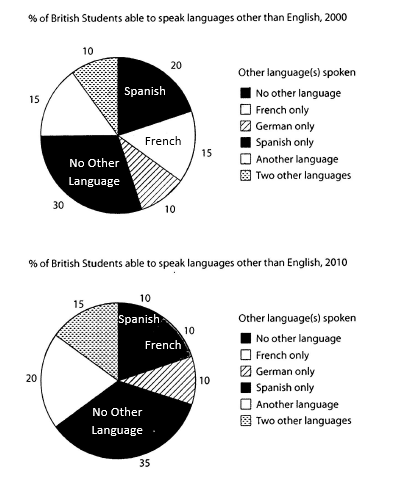
The charts below show the proportions of British students at one university in England who were able to speak other languages in addition to English, in 2000 and 2010
Summarise the information by selecting and reporting the main features, and make comparisons where relevant.
Student answer (Band 5.0)
The two given charts show the proportions of British students at one one university in England who were able to speak other languages in addition to English, in 2000 and 2010.
The first chart gives information about the proportion of British students to speak other languages in addition to English. In 2000, 20% British students were able to speak Spanish while half of that about 10% were able to speak Spanish in 2010. In 2000 and 2010, 15% and 10% British students respectively, were able to speak French. Both in 2000 and 2010,10% British students were familiar with German language. In 2000, 15% British students were able to speak other language while 20% students in 2010. In 2000, 10% British students were able to speak in two other languages while 15% students in 2010. In 2000, 35% British students were not familiar with any other language as 35% students weren't familiar in 2010.
AI examiner evaluation
| Criterion | Band |
|---|---|
| Task Achievement / Task Response | 4.0 |
| Coherence and Cohesion | 4.5 |
| Lexical Resource | 5.5 |
| Grammatical Range and Accuracy | 5.0 |
| Overall | 5.0 |
Task Achievement / Task Response: Band 4.0
You report several relevant categories and comparisons, including Spanish falling from 20% to 10%, French from 15% to 10%, and “another language” rising from 15% to 20%. However, the response is only 116 words, below the 150-word minimum, and it lacks a clear overview of the main pattern. The most important error is the claim that 35% spoke no other language in 2000: the chart shows 30%; 35% applies to 2010. The opening repeats the task rather than summarising the charts, and the response does not clearly highlight the overall rise in students speaking no other language and the decline in Spanish and French. Add an overview and check every figure against the chart.
Coherence and Cohesion: Band 4.5
The information is presented in a broadly chronological order, moving through the language categories and comparing 2000 with 2010. This gives the reader a basic route through the data. However, the response is one continuous paragraph, with no distinct overview or grouping of related information, so the progression feels like a list of figures rather than a developed summary. Repeated openings such as “In 2000” also make the linking mechanical. Use an overview paragraph followed by a body paragraph grouping increases and decreases, and vary the comparison structures—for example, “By contrast” or “while”—to make relationships clearer.
Lexical Resource: Band 5.5
You use enough topic vocabulary to identify the categories, including “proportions,” “able to speak,” “familiar with,” and “two other languages.” The language is generally understandable, but the range is repetitive and some expressions are imprecise or unnatural. For example, “speak in two other languages” is less suitable than “speak two other languages,” while “were familiar with German language” does not accurately express the chart’s category as clearly as “could speak German.” “Other language” also needs more precise phrasing when referring to the chart category. Aim for concise, accurate reporting verbs and collocations rather than repeating “were able to speak” in every sentence.
Grammatical Range and Accuracy: Band 5.0
Most sentences use a basic past-tense reporting pattern, and the comparisons are usually understandable. However, the range of sentence structures is limited, and recurring errors affect accuracy. In “20% British students,” the plural noun phrase needs a determiner (“20% of British students”); similar omissions occur throughout. The opening has a duplicated word in “one one university,” and punctuation is inconsistent, as in “2010,10%.” The sentence beginning “In 2000, 35%...” also has an unclear comparison structure. Practise accurate percentage constructions and combine related figures using controlled clauses with “while” or “whereas.”
See this exact question answered at other band scores. The same prompt compared across bands.
Browse more IELTS Writing model answers or get your own writing scored by the same AI examiner.