Band 6.0 IELTS Writing Task 1 Model Answer
Overall Band Score: 6.0 · Cambridge IELTS 11 · 2026-11-11
IELTS Writing Task 1 question
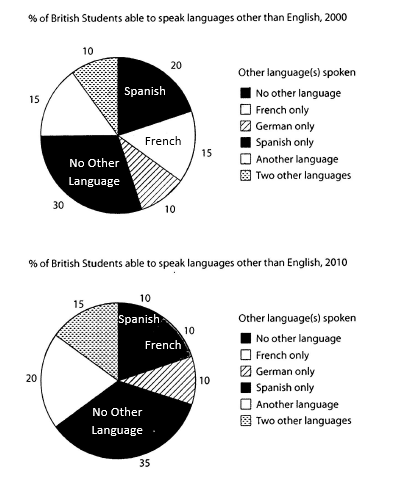
The charts below show the proportions of British students at one university in England who were able to speak other languages in addition to English, in 2000 and 2010
Summarise the information by selecting and reporting the main features, and make comparisons where relevant.
Student answer (Band 6.0)
This chart illustrate the percentage of multiple languages speakers british students in both years 2000 and 2010.
We see that the british students french speakers and english only speakers are the majority of the percentage in 2000, yet that was not the case in 2010, because as we can see 35% of students were speaking one language only, while the french speakers went down to 10%.
In addition to that, in 2000 spanish language comes as second language preferred by english students, just under the french with a 20% of speakers, which has decreased significantly in 2010 to only 10%. moreover, 15% of students are leaning more toward speaking two more languages in 2010, which has been increasing since 2000.
An interesting fact is that the german language speakers percentage is stable through both years 2000 and 2010, which makes it the least spoken language between english students.
in conclusion, we can conclude that english students are slowly losing interest in learning or speaking more than their own language.
AI examiner evaluation
| Criterion | Band |
|---|---|
| Task Achievement / Task Response | 5.5 |
| Coherence and Cohesion | 6.5 |
| Lexical Resource | 5.5 |
| Grammatical Range and Accuracy | 5.5 |
| Overall | 6.0 |
Task Achievement / Task Response: Band 5.5
You identify several relevant changes, including the rise in students reporting no other language (to 35%), the fall in French and Spanish, and the increase in students speaking two other languages. However, some key information is misinterpreted: in 2000, Spanish at 20% was the largest language category, not French, and German at 10% was not the least spoken because two other languages also accounted for 10%. The claim that students are “slowly losing interest” is too broad: the share with no other language rose, but the proportions speaking another language or two other languages also increased. Include a clearer overview of the main pattern and report the categories more precisely.
Coherence and Cohesion: Band 6.5
The response has a recognisable progression: it introduces the charts, discusses changes in language categories, and ends with a conclusion. Paragraph breaks help separate these stages, and linking expressions such as “In addition to that” and “in conclusion” make relationships between points visible. This provides coherent overall organisation. However, some connections are mechanical, and the conclusion repeats the preceding interpretation rather than synthesising the chart accurately. The reference in “which has been increasing” is also not fully clear, although it appears to refer to the share speaking two other languages. Grouping the figures into a clearer comparison of increases, decreases, and unchanged proportions would make the progression more controlled and the comparisons easier to follow.
Lexical Resource: Band 5.5
You use a range of task-related vocabulary, including “percentage,” “decreased significantly,” “stable,” and “speakers,” so the main topic is generally understandable. However, several word choices and collocations are inaccurate or awkward, such as “percentage of multiple languages speakers,” “language preferred,” and “leaning more toward speaking.” “English only speakers” is also misleading here, since the chart category is students who speak no other language, not a separate English-only speaker group. Repetition of “students,” “speakers,” and “language” limits flexibility, while “losing interest” introduces an unsupported interpretation. Aim for precise chart language such as “the proportion of students” and “the share speaking another language,” and use category labels consistently.
Grammatical Range and Accuracy: Band 5.5
You attempt both simple and more complex sentence forms, including a contrast with “yet” and a reason clause beginning “because.” The overall meaning can usually be followed, but errors in sentence structure and grammatical control are noticeable. For example, “This chart illustrate” has subject–verb disagreement, and “the british students french speakers and english only speakers are the majority” lacks a clear grammatical structure. In “just under the french with a 20%,” the comparison is also awkwardly formed, and “the german language speakers percentage is stable” uses an unclear noun sequence. Capitalisation of “British,” “French,” and “German” also needs attention. Build shorter, well-formed comparisons first, then add complex clauses with accurate agreement and articles.
See this exact question answered at other band scores. The same prompt compared across bands.
Browse more IELTS Writing model answers or get your own writing scored by the same AI examiner.