Band 6.0 IELTS Writing Task 1 Model Answer
Overall Band Score: 6.0 · Cambridge IELTS 11 · 2026-11-11
IELTS Writing Task 1 question
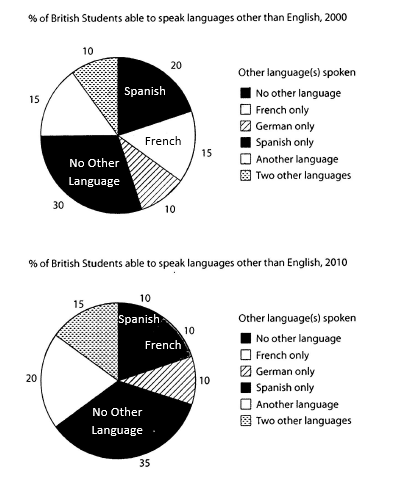
The charts below show the proportions of British students at one university in England who were able to speak other languages in addition to English, in 2000 and 2010
Summarise the information by selecting and reporting the main features, and make comparisons where relevant.
Student answer (Band 6.0)
The given pie charts illustrate the proportions of British students at a university in England who knew other languages alongside English in 2000 and 2010. Overall, in both years, the majority of students spoke only English. The proportions of students speaking one other language or two other languages have increased; in contrast, students speaking French and Spanish have decreased, and German-speaking students have remained constant.
In 2000, covering the largest share, 30% of students were able to speak only English, followed by Spanish at 20%, French and another language at 15% each, also two other languages, and German at 10% each.
By 2010, the proportions of students who knew only English rose to 35%, student who sould speak other language at 20%, who could speak two languages at 15%.
AI examiner evaluation
| Criterion | Band |
|---|---|
| Task Achievement / Task Response | 5.5 |
| Coherence and Cohesion | 6.0 |
| Lexical Resource | 6.0 |
| Grammatical Range and Accuracy | 5.5 |
| Overall | 6.0 |
Task Achievement / Task Response: Band 5.5
You identify the charts, give a relevant overview, and report several accurate figures: English-only speakers rose from 30% to 35%, while “another language” and two other languages increased. You also correctly note that German remained unchanged and Spanish and French declined. However, the overview says the majority spoke only English, which is not supported by either chart: the largest group was still less than half. The 2010 account is incomplete, omitting the figures for French, Spanish and German, and the response does not reach the required 150 words. Develop the comparison by reporting all key categories and clarifying that English-only students formed the largest group, rather than a majority.
Coherence and Cohesion: Band 6.0
The response has a clear basic structure: an introduction and overview are followed by a paragraph on 2000 and one on 2010. The contrast marker “in contrast” helps signal the main trends, and the sequence from overview to details is easy to follow. However, the final paragraph stops after three categories, leaving the comparison unfinished; this weakens progression and makes the ending feel abrupt. The long list in the 2000 paragraph is also difficult to process, particularly where several categories are joined with commas and “also.” Use separate, parallel comparisons for the categories, and ensure the final paragraph completes the 2010 data before concluding.
Lexical Resource: Band 6.0
You use an adequate range of task-related vocabulary, including “proportions,” “illustrate,” “remained constant,” and “decreased,” and the meaning is generally clear. There is some variation in how you describe language ability, such as “spoke” and “were able to speak.” However, “covering the largest share” is an awkward collocation, and “knew other languages” is less precise than describing students as able to speak them. The phrase “student who sould speak other language” contains spelling and word-choice problems that reduce accuracy. Aim for consistent, precise labels such as “students speaking another language” and “the proportion of students,” and check spelling before submitting.
Grammatical Range and Accuracy: Band 5.5
You use both simple sentences and a more complex overview sentence, including the contrast structure “in contrast,” and most of the message remains understandable. Some grammatical errors are present, especially in the final paragraph: “student who sould speak other language at 20%” lacks a plural subject and a complete clause, while “who could speak two languages at 15%” is also a fragment. In the 2000 sentence, the list structure after “followed by” is not consistently formed, making the relationships between categories unclear. Build complete sentences with a clear subject and verb—for example, “The proportion speaking another language rose to 20%”—and use parallel grammatical forms when listing figures.
See this exact question answered at other band scores. The same prompt compared across bands.
Browse more IELTS Writing model answers or get your own writing scored by the same AI examiner.