Band 4.5 IELTS Writing Task 1 Model Answer
Overall Band Score: 4.5 · Cambridge IELTS 11 · 2026-11-11
IELTS Writing Task 1 question
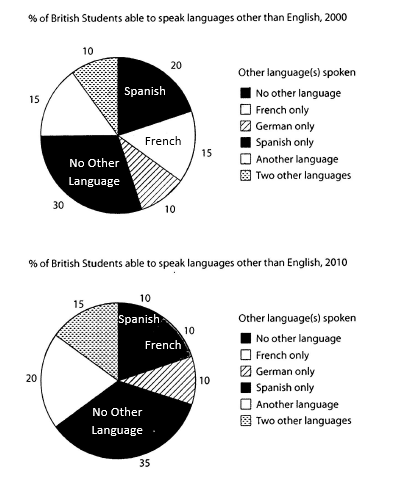
The charts below show the proportions of British students at one university in England who were able to speak other languages in addition to English, in 2000 and 2010
Summarise the information by selecting and reporting the main features, and make comparisons where relevant.
Student answer (Band 4.5)
It says that in 2000 the British students able to speak little bit German and full of Spanish language, but in 2010 they have the same experience like it does not change anything. So they need to practice on it and learn something new, 10 percent of two other language have been spoken in 2000 and and 10 percent of German language, and 30 percent of no other language, but in 2010 it completely change something in it like here we can see that 5 percent increase in two other language like now it goes to 15 percent in other language spoken and the German language has the same scene like it does not change but need to work on it and no other language increase 5 percent here also and now it goes to 15 percent and in last Spanish language and French also 10 percent here. It help also in French language in 2010
AI examiner evaluation
| Criterion | Band |
|---|---|
| Task Achievement / Task Response | 4.5 |
| Coherence and Cohesion | 3.5 |
| Lexical Resource | 4.5 |
| Grammatical Range and Accuracy | 4.5 |
| Overall | 4.5 |
Task Achievement / Task Response: Band 4.5
You include several figures from both years, such as German remaining at 10% and the share speaking two other languages rising from 10% to 15%. However, the response does not clearly summarise the charts: it gives no concise overview of the main pattern, and some figures are misreported. For example, “no other language” rose from 30% to 35%, not to 15%, while Spanish fell from 20% to 10%; the response does not accurately explain this change. Comments such as “they need to practice” and “need to work on it” are advice rather than chart description. Focus on the largest changes and stable categories, and report them accurately without adding opinions.
Coherence and Cohesion: Band 3.5
The response makes an attempt to compare 2000 with 2010 and uses time markers such as “in 2000,” “in 2010,” and “now.” However, the information is presented as one long, loosely connected sequence, so the reader has difficulty following the comparisons. Repeated phrases such as “like it does not change” and “here also” do not clearly show how the figures relate. There is no distinct overview or grouping of categories. Organise the response into a brief introduction, an overview, and paragraphs comparing related figures; use clear links such as “by contrast” and “while” to show changes and similarities.
Lexical Resource: Band 4.5
Your vocabulary is basic and repetitive, with repeated use of “language,” “change,” and “like.” Some wording makes the intended meaning difficult to understand, as in “little bit German and full of Spanish language” and “the same scene.” The phrase “other language spoken” is also unclear when describing the category for students speaking two other languages. You do use relevant terms such as “percent” and name the language categories, which helps convey some chart information. To improve, learn precise chart-description vocabulary and natural collocations, for example “the proportion rose,” “remained unchanged,” and “students who spoke no other language.”
Grammatical Range and Accuracy: Band 4.5
The response attempts longer sentences and comparisons, but grammatical errors are frequent and sometimes make relationships between ideas unclear. For example, “in 2000 the British students able to speak” lacks a clear verb structure, while “10 percent of two other language have been spoken” has problems with the subject and verb form. The sentence beginning “but in 2010 it completely change” also shifts tense and does not form a clear comparison. Punctuation and sentence boundaries are weak, particularly in the extended final sequence. Practise accurate simple comparison patterns first, such as “The figure increased from 10% to 15%,” then combine them using “while” or “whereas.”
See this exact question answered at other band scores. The same prompt compared across bands.
Browse more IELTS Writing model answers or get your own writing scored by the same AI examiner.