Band 5.5 IELTS Writing Task 1 Model Answer
Overall Band Score: 5.5 · Cambridge IELTS 11 · 2026-11-11
IELTS Writing Task 1 question
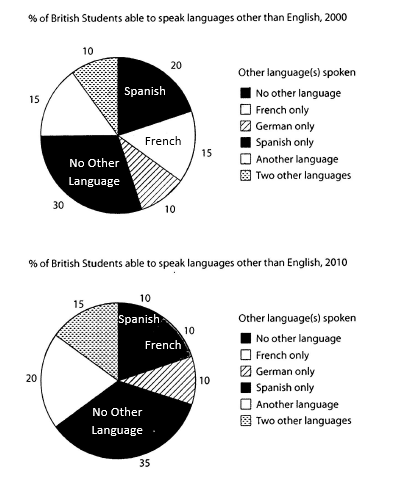
The charts below show the proportions of British students at one university in England who were able to speak other languages in addition to English, in 2000 and 2010
Summarise the information by selecting and reporting the main features, and make comparisons where relevant.
Student answer (Band 5.5)
The two pie charts illustrate the percentage of British Students able to speak languages other than English between 2000 and 2010.
Overall, the proportion of no other language accounted for the highest throughout the period, while German had the same and least proportion during this period.
In 2000, no other language accounted for the highest proportion of british students which able to speak languages other than English was 30%, which was followed by the Spanish to about 20%. French and Other languages demonstrated the same proportion at 15%. Similarly, German and Two other languages had the similar in their percentage to 10%.
In 2010, no other language remained the largest in this year at 35%. Another languages displayed the second highest proportion to 20%. Two other languages depicted a slight increase in their proportion (15%). Moreover, Spanish, French and German had the same proportion at 10% in 2010.
AI examiner evaluation
| Criterion | Band |
|---|---|
| Task Achievement / Task Response | 5.5 |
| Coherence and Cohesion | 6.0 |
| Lexical Resource | 5.5 |
| Grammatical Range and Accuracy | 5.5 |
| Overall | 5.5 |
Task Achievement / Task Response: Band 5.5
You identify the main pattern that “no other language” was the largest category in both years, and you report most figures accurately, including the rise from 30% to 35% and the fall in Spanish from 20% to 10%. However, the overview says German had the “least proportion,” which is not true in 2000: German and two other languages were both at 10%, while German was tied with Spanish and French at 10% in 2010. The response also does not clearly summarise the overall shift towards speaking multiple other languages. At 148 words, it is two words below the required minimum. Add a concise overview of the key changes and check the comparisons before finalising.
Coherence and Cohesion: Band 6.0
The response has a clear overall arrangement: an introduction, an overview, and separate paragraphs for 2000 and 2010. This makes the year-by-year information easy to follow, and phrases such as “In 2010” signal the change in focus. However, the overview’s claim about German being the least category conflicts with the figures that follow, weakening the progression of ideas. Some linking is also mechanical, particularly the repeated use of “which” and “Moreover,” and the long sentence beginning “In 2000” carries several comparisons at once. Use more direct sentence structures and connect the two years through explicit comparisons, such as noting that Spanish declined while “another language” and “two other languages” increased.
Lexical Resource: Band 5.5
You use a reasonable range of chart vocabulary, including “proportion,” “accounted for,” “remained,” and “increase,” and the meaning is generally understandable. However, several choices are inaccurate or unnatural: “the proportion of no other language” and “Another languages displayed” do not express the categories naturally, while “had the similar in their percentage” is unclear. Capitalisation is also inconsistent in “British Students” and “british students.” Aim for precise, conventional phrasing such as “the share of students speaking no other language” and “both categories stood at 10%.” Avoid using several near-synonyms such as “demonstrated,” “displayed,” and “depicted” where a simple verb like “was” or “rose” is clearer.
Grammatical Range and Accuracy: Band 5.5
You attempt both simple and more complex sentences, including a relative clause in “which was followed by the Spanish” and a contrast introduced by “while.” However, some sentence structures are faulty or incomplete. For example, “German had the same and least proportion” lacks a clear grammatical complement, and “British students which able to speak” is missing the verb “were.” The sentence beginning “In 2000” also becomes difficult to control because several clauses and comparisons are joined together. Practise forming accurate comparative sentences, for example, “German and two other languages each accounted for 10%.” Check subject–verb agreement and ensure relative clauses have a complete verb phrase before adding more complex structures.
See this exact question answered at other band scores. The same prompt compared across bands.
Browse more IELTS Writing model answers or get your own writing scored by the same AI examiner.