Band 6.0 IELTS Writing Task 1 Model Answer
Overall Band Score: 6.0 · Cambridge IELTS 11 · 2026-11-11
IELTS Writing Task 1 question
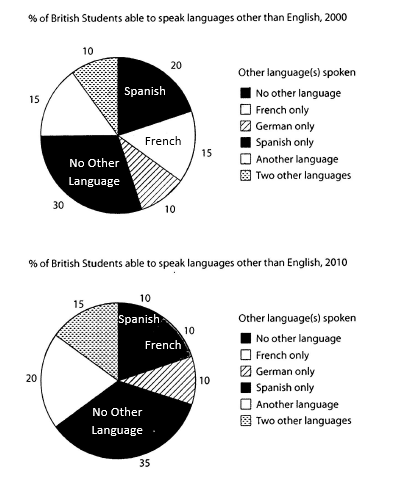
The charts below show the proportions of British students at one university in England who were able to speak other languages in addition to English, in 2000 and 2010
Summarise the information by selecting and reporting the main features, and make comparisons where relevant.
Student answer (Band 6.0)
The pie charts illustrate the percentage of British Students at a educational institute in England who can speak English along with other languages, in the year 2000 and 2010.
Overall, students that spoke no other languages has the highest proportion in both year 2000 ad 2010. On the other hand, the lowest proportion in language speaking include german that remain the same in both given years. Other language spoken shown slight change in percentage.
By comparising the proportion of students that spoke no languages other than English in year 2000 and 2010, there's a modest increase in percentage from 30% to 35% respectively, same goes to percentage of students spoke another language and two other languages that were increased by 5%.
In contrast, the percentage of students shows a slight dereased in spanish and french languages spoke. the proportion of spanish language show a modest decrease of 10% and turn out 10% in 2010 which was previously 20% in 2000. In addition, the proportion of students spoke french decreased from 15% to 10%. While the german language proportion remains the same in both years.
AI examiner evaluation
| Criterion | Band |
|---|---|
| Task Achievement / Task Response | 6.0 |
| Coherence and Cohesion | 6.0 |
| Lexical Resource | 5.5 |
| Grammatical Range and Accuracy | 5.5 |
| Overall | 6.0 |
Task Achievement / Task Response: Band 6.0
The response identifies the main overall pattern: “No other languages” is the largest category in both years, while German remains unchanged. It also reports the key figures for these categories and correctly notes the increases in “another language” and “two other languages,” as well as the falls in Spanish and French. This addresses the task with relevant comparisons. However, some details are unclear or incomplete: “the lowest proportion” is attributed to German, although German is tied with “two other languages” in 2000 and is not the smallest category in 2010. The overview’s statement that other-language speaking showed a “slight change” is also vague, despite increases of five percentage points in both relevant categories. Make the overview more precise and distinguish the categories consistently.
Coherence and Cohesion: Band 6.0
The response has a clear four-paragraph structure, moving from an introduction and overview to comparisons of increases and decreases. This gives the reader a generally coherent route through the data. Linking phrases such as “Overall,” “On the other hand,” “In contrast,” and “In addition” help signal relationships, although some are used mechanically or do not express the relationship precisely. For example, “same goes to” introduces two increases but is informal, and the final “While” clause is left as a fragment. The reference to “Other language spoken” in the overview is also not fully clear about which categories are meant. Improve cohesion by grouping related categories explicitly and using complete, smoothly connected sentences.
Lexical Resource: Band 5.5
The response uses relevant chart vocabulary, including “proportion,” “percentage,” “increase,” “decrease,” and “remains the same,” so the main comparisons are understandable. It also attempts more formal phrasing, such as “By comparising the proportion,” but several word choices, forms, and collocations are inaccurate or awkward. Examples include “a educational institute,” “language speaking,” “slight dereased,” and “the proportion of spanish language.” Capitalisation is inconsistent for “British,” “German,” and “Spanish.” These issues make the wording less natural and sometimes obscure the intended category, even though the overall meaning can usually be followed. Aim for precise chart phrases such as “the proportion of students speaking Spanish” and check spelling and language names.
Grammatical Range and Accuracy: Band 5.5
There is a mix of simple and more complex sentence forms, and the response generally communicates the comparisons. Some grammatical errors remain, particularly with agreement, articles, and sentence construction. For example, “students that spoke no other languages has” should use a plural verb, while “in a educational institute” has an incorrect article. The phrase “students spoke another language” needs a grammatical link such as “students who spoke another language,” and “While the german language proportion remains the same in both years” is a dependent clause presented as a sentence. Tense and clause control are also uneven in “the proportion of spanish language show.” Review subject–verb agreement and ensure each sentence has a complete main clause; these corrections would make the data easier to read.
See this exact question answered at other band scores. The same prompt compared across bands.
Browse more IELTS Writing model answers or get your own writing scored by the same AI examiner.