Band 6.5 IELTS Writing Task 1 Model Answer
Overall Band Score: 6.5 · Cambridge IELTS 11 · 2026-11-11
IELTS Writing Task 1 question
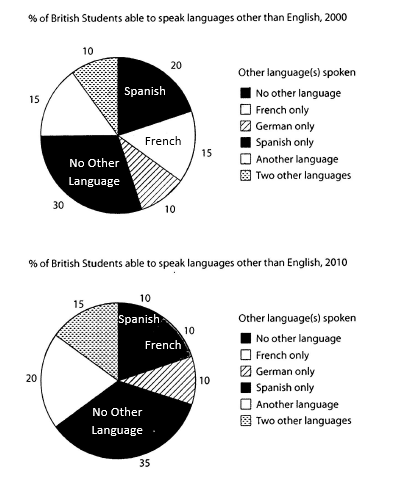
The charts below show the proportions of British students at one university in England who were able to speak other languages in addition to English, in 2000 and 2010
Summarise the information by selecting and reporting the main features, and make comparisons where relevant.
Student answer (Band 6.5)
The pie charts compare the percentage of students belonging to Britain at a tertiary education institution who spoke languages other then English in the years 2000 and 2010.
Overall, there was a substancial increase in the number of students who could speak two other languages and no other language. Conversely, the proportion of only German speaker remained largely constant while a decline in the number of those who only spoke either french or spanish was quite evident.
In the year 2000 pupils who could speak spanish or french only made up 20% and 15% of the total strength respectively however the number lowered down to 10% for both by 2010.
Students able to converse in deutsch maintained 10% of the total strength even after the 10-year gap while both the number of students speaking no other language except english and those who could speak another language except those given rose by 5% to reach 35% and 20% respectively by 2010.
AI examiner evaluation
| Criterion | Band |
|---|---|
| Task Achievement / Task Response | 7.0 |
| Coherence and Cohesion | 7.0 |
| Lexical Resource | 6.0 |
| Grammatical Range and Accuracy | 6.0 |
| Overall | 6.5 |
Task Achievement / Task Response: Band 7.0
The response identifies the main overall changes and reports the key figures accurately: Spanish falls from 20% to 10%, French from 15% to 10%, German remains at 10%, and the no-other-language and another-language categories rise to 35% and 20%. The overview also notes the increase in students speaking two other languages, although it would be stronger if it gave the figures (10% to 15%) and clearly distinguished this group from students speaking one additional language. The comparison of the two years is relevant and covers the chart categories, but some descriptions are imprecise: “number” is used where the charts show proportions, and “only German speaker” is singular despite describing a category. More precise overview wording and fuller reporting of the two-language category would strengthen the account.
Coherence and Cohesion: Band 7.0
The response is organised into a clear introduction, an overview and two detail paragraphs, and the information progresses logically from the broad trends to specific comparisons. Linking expressions such as “Overall,” “Conversely,” and “while” help signal contrast, and the final paragraph groups the stable and rising categories effectively. Some cohesion is less controlled because the long final sentence combines several categories and changes in one structure, making the comparisons harder to follow. The phrase “those who could speak another language except those given” also makes the reference to the chart category less clear. Use shorter, parallel comparisons and refer consistently to categories—for example, “the ‘another language’ group” and “students speaking two other languages”—to make the progression more precise.
Lexical Resource: Band 6.0
There is adequate vocabulary for describing the charts, including “proportion,” “decline,” “remained largely constant,” and “rose by 5%.” The writer also attempts more formal expressions such as “tertiary education institution” and “total strength,” but these are unnatural or imprecise in this context; “university” and “share of students” would be clearer. Several spelling errors, including “substancial,” “then” for “than,” and “spanish,” reduce accuracy. “Deutsch” is not the appropriate English label for the chart’s German category. The range is sufficient to communicate the main trends, but more natural collocations and accurate spelling would make the report more fluent and precise.
Grammatical Range and Accuracy: Band 6.0
The response uses a mix of simple and complex structures, including a contrast clause in “while a decline … was quite evident” and a relative clause in “students who could speak.” Most meanings remain clear, but some grammatical choices are awkward or inaccurate. In “students belonging to Britain,” the relationship between the students and the country is not expressed naturally; “British students” is the appropriate construction. The sentence beginning “In the year 2000” also needs clearer punctuation between its two contrasting clauses, and “the number lowered down to 10%” has an unsuitable verb pattern for describing a proportion. Aim for cleaner sentence boundaries and use structures such as “the proportion fell to 10%.”
See this exact question answered at other band scores. The same prompt compared across bands.
Browse more IELTS Writing model answers or get your own writing scored by the same AI examiner.