Band 5.0 IELTS Writing Task 1 Model Answer
Overall Band Score: 5.0 · Cambridge IELTS 11 · 2026-11-11
IELTS Writing Task 1 question
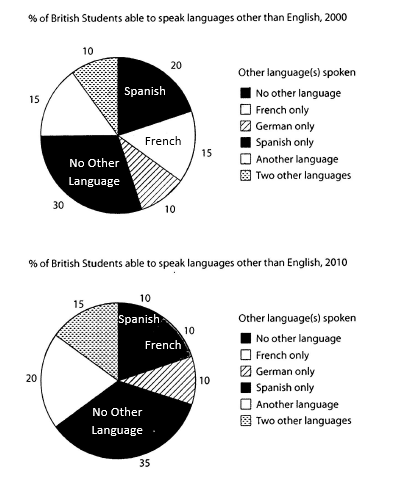
The charts below show the proportions of British students at one university in England who were able to speak other languages in addition to English, in 2000 and 2010
Summarise the information by selecting and reporting the main features, and make comparisons where relevant.
Student answer (Band 5.0)
The pie charts illustrate the proportions of British students at one university in England who were able to speak other languages in addition to English, in 2000 and 2010.
From the charts we can behold that a huge amount of students could not speak other language except English in 2000 additonally it increased 5% in 2010.On the other hand, the amount of the students could speak 10% in 2000 but increased 5% in 2010. However, the percentange of Spanish spoken students declined half of the perevious but the number of French known students also rised up as other languages . Besides, two other languages known students grew 5% than 2000. But there is language that remained stable since 2000 and it is Germen known students.
Analyzing the charts , we can see that most of students in England are not bilingual . However there is a few people who felt interested in learning another language . At the end the number of the German spoken studends remained same as previous year in 2000.
AI examiner evaluation
| Criterion | Band |
|---|---|
| Task Achievement / Task Response | 5.0 |
| Coherence and Cohesion | 4.5 |
| Lexical Resource | 5.0 |
| Grammatical Range and Accuracy | 5.0 |
| Overall | 5.0 |
Task Achievement / Task Response: Band 5.0
You identify the topic and report several relevant changes, including the rise in students speaking no other language (30% to 35%), the fall in Spanish (20% to 10%), and the stable German figure (10%). However, the overview is unclear and some comparisons are inaccurate: French fell from 15% to 10%, but you say it “rised up,” and the statement that students who “could speak 10%” increased by 5% does not identify a category clearly. The final claim that most students are not bilingual is not supported by the figures, since the no-other-language group is 35% in 2010. The response is also 148 words, below the required 150; the 25 words copied from the prompt are excluded from the count. Add a clear overview and report the categories accurately.
Coherence and Cohesion: Band 4.5
The response has an opening, a paragraph describing changes, and a concluding paragraph, so there is some attempt to organise the information. However, the progression is difficult to follow because several categories are not named clearly, as in “the amount of the students could speak 10%,” and the conclusion repeats the point about German rather than synthesising the main trends. Linking phrases such as “On the other hand,” “However,” and “Besides” are used, but their relationships are sometimes unclear or repetitive. Group the figures into a logical comparison—for example, increases, decreases, and unchanged values—and use clear references to each language. This would make the organisation easier to follow.
Lexical Resource: Band 5.0
You use some task-related vocabulary, including “proportions,” “remained stable,” and “declined,” which helps communicate the chart topic. However, the range is limited and several word choices or collocations are inaccurate, making parts of the report hard to understand. For example, “a huge amount of students” is not a natural way to describe a proportion, while “French known students” and “German spoken students” are awkward. There are also noticeable spelling errors, including “additonally,” “perevious,” “Germen,” and “studends.” Use precise chart language such as “the proportion of students who spoke French” and check spelling carefully. More accurate phrasing would make your comparisons clearer.
Grammatical Range and Accuracy: Band 5.0
You attempt both simple and more complex sentences, including a contrast introduced by “However” and a relative clause in “language that remained stable.” Nevertheless, errors are frequent, and some sentence structures make the intended meaning difficult to follow. For example, “the amount of the students could speak 10%” lacks a clear grammatical structure, while “the number of French known students also rised up” has problems with the verb form and sentence construction. There are also missing spaces after full stops and inconsistent punctuation, as in “2010.On the other hand”. Practise forming complete comparison sentences with a clear subject and verb, such as “The proportion speaking French fell from 15% to 10%.”
See this exact question answered at other band scores. The same prompt compared across bands.
Browse more IELTS Writing model answers or get your own writing scored by the same AI examiner.