Band 5.5 IELTS Writing Task 1 Model Answer
Overall Band Score: 5.5 · Cambridge IELTS 11 · 2026-11-12
IELTS Writing Task 1 question
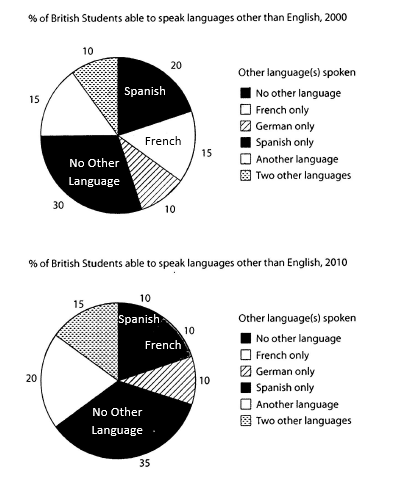
The charts below show the proportions of British students at one university in England who were able to speak other languages in addition to English, in 2000 and 2010
Summarise the information by selecting and reporting the main features, and make comparisons where relevant.
Student answer (Band 5.5)
The two pie charts illustrates the percentages of British students who could speak different languages other than English at a university in 2000 and 2010.
Overall, highest proportion of learners were able to talk in English but no other language, Whereas, least number of students could speak only German language at a university in two years.
The students who cannot speak any other language except English were present with percentage of 30% in 2000 and 35% in 2010. 10% British students were able to speak German only in both time period, while and French languages were spoken 15%, in 2000 but 10% in 2010.
Two different languages with proportion of 10% in one year and 15% in other year were spoken by the learners of Britain university. The pupils who could talk Spanish were 20% in the early twenty first century, while only 10% in 2010. Lastly, only 15% student were able to speak another language in 2000, while 20% in 2010 in the university.
AI examiner evaluation
| Criterion | Band |
|---|---|
| Task Achievement / Task Response | 6.0 |
| Coherence and Cohesion | 5.5 |
| Lexical Resource | 5.5 |
| Grammatical Range and Accuracy | 5.0 |
| Overall | 5.5 |
Task Achievement / Task Response: Band 6.0
You cover the main categories in both years and report most figures accurately, including the rise in students speaking no other language (30% to 35%), the fall in Spanish (20% to 10%), and the increase in another language (15% to 20%). Your overview identifies the largest group correctly, but the claim that German was the smallest category is inaccurate: German was tied with two other languages in 2000 and was not the smallest in 2010, when Spanish and French were both at 10%. The description of the two-language category is also vague because it does not clearly assign each percentage to a year. Make the overview more precise and compare the main changes directly.
Coherence and Cohesion: Band 5.5
The response has a recognisable structure: an introduction, an overview, and two paragraphs reporting details. This gives the reader a basic route through the information, and words such as “while” and “Lastly” help connect comparisons. However, progression is not consistently clear. The sentence beginning “Two different languages with proportion…” leaves the reader to infer which figure belongs to which year, and “while and French languages…” disrupts the link between ideas. The final paragraph also groups categories without a clear comparison pattern. Organise the details by changes over time or by related categories, and use explicit references such as “in 2000” and “by 2010” for each figure.
Lexical Resource: Band 5.5
You use enough topic vocabulary to communicate the chart’s subject, including “percentages,” “proportion,” and “another language.” There is also some attempt to vary wording, for example “learners,” “pupils,” and “students.” However, several choices are unnatural or imprecise for describing chart data: “talk in English,” “were present with percentage,” and “two different languages … were spoken by the learners” make the meaning less direct. “Early twenty first century” is unnecessarily elaborate for 2000, and “only German language” is awkward. Prefer standard reporting collocations such as “accounted for,” “the proportion of students,” and “could speak German only.” This would make the description more precise and natural.
Grammatical Range and Accuracy: Band 5.0
You attempt a mixture of simple and more complex sentences, including comparisons with “while,” and the main information is generally understandable. However, some errors in agreement, sentence construction, and punctuation reduce accuracy. For example, “The two pie charts illustrates” should use a plural verb, while “highest proportion … were” has a mismatch between the singular subject and verb. The construction “while and French languages were spoken 15%” is faulty, and “in both time period” needs a plural noun. Capitalisation after “Whereas” is also incorrect within the sentence. Check subject–verb agreement, articles and plurals, and build each comparison as a complete, parallel sentence.
See this exact question answered at other band scores. The same prompt compared across bands.
Browse more IELTS Writing model answers or get your own writing scored by the same AI examiner.