Band 6.5 IELTS Writing Task 1 Model Answer
Overall Band Score: 6.5 · Cambridge IELTS 11 · 2026-11-12
IELTS Writing Task 1 question
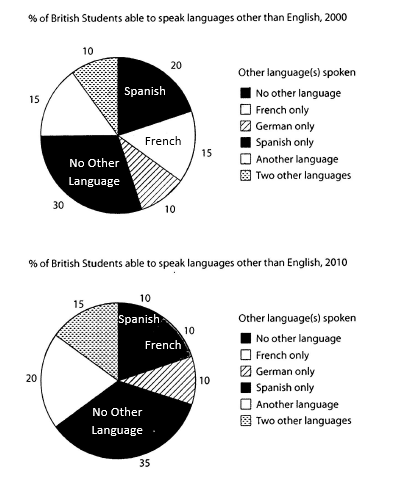
The charts below show the proportions of British students at one university in England who were able to speak other languages in addition to English, in 2000 and 2010
Summarise the information by selecting and reporting the main features, and make comparisons where relevant.
Student answer (Band 6.5)
The two pie charts compare the proportions of British university students in England who were able to speak other languages other than English, in 2000 and 2010.
Overall, a large proportion of students did not knew other language in addition to English. After ten years, the proportions of no other language, two other languages, and another language speakers increased. Spanish and French speakers decreased considerably, while the percentages of German speakers remain unchanged.
In 2000, 20% of British students in one university spoke Spanish other than English and 15% students spoke French. However, in 2010, there numbers decreased significantly, showing 10% were Spanish speakers and 10 % were French speakers despite English. In terms of German speakers, there number remained same at 10% in both years.
On the other hand, in 2000, 10% of students knew two other languages, 30% knew no other language ,and 15% of students spoke another language. While in 2010, the percentages for these sectors rose 5% more than their previous values, such as 15%, 35%, and 20%, respectively.
AI examiner evaluation
| Criterion | Band |
|---|---|
| Task Achievement / Task Response | 7.0 |
| Coherence and Cohesion | 7.0 |
| Lexical Resource | 6.0 |
| Grammatical Range and Accuracy | 5.5 |
| Overall | 6.5 |
Task Achievement / Task Response: Band 7.0
You cover the main categories in both charts and give a clear overview of the key changes: the shares for students speaking no other language, two other languages, or another language rose, while Spanish and French fell and German stayed level. The figures you report are consistent with the charts, including the 5-point increases and the unchanged 10% for German. This selection and comparison make the response well-focused and supported. To make the account more fully developed, state the most notable overall contrast more explicitly: students with no other language were the largest group in both years, and this share grew from 30% to 35%. Also avoid the slightly broad phrase “a large proportion” without immediately anchoring it in the figures.
Coherence and Cohesion: Band 7.0
The response is organised in a clear sequence: an introduction, an overview, then paragraphs comparing the language groups. The overview prepares the reader for the detailed figures, and phrases such as “In 2000” and “On the other hand” help signal shifts between comparisons. The final paragraph also groups the three categories that increased, which supports progression. Some linking is less precise than the overall structure: “On the other hand” suggests a stronger opposition than is needed, and “While in 2010” begins a fragment rather than a complete contrast. Use a full sentence and choose transitions that show the exact relationship between the data. Clearer referencing would also help avoid repeated “there” constructions.
Lexical Resource: Band 6.0
You use an adequate range of chart-reporting vocabulary, including “proportions,” “decreased significantly,” “remained,” and “percentages,” and the meaning is generally clear. There are also attempts to vary descriptions of the groups, such as “Spanish speakers” and “students knew two other languages.” However, some word choices and collocations are inaccurate or repetitive. “Other languages other than English” is redundant, while “spoke another language” and “knew no other language” could be expressed more precisely as language categories. “There numbers” is also an incorrect word choice in context. Aim for consistent, concise terms such as “the proportion of students speaking Spanish” and “the share reporting no other language.”
Grammatical Range and Accuracy: Band 5.5
You attempt a mix of simple and more complex structures, including the overview sentence with “while” and the comparison beginning “In 2000.” Most of the data remains understandable, but some grammatical errors recur and occasionally make the sentence structure awkward. For example, “did not knew” should use the base form after “did” (“did not know”), and “While in 2010, the percentages…” is a dependent clause without a main clause. There are also agreement and possessive errors in “there numbers” and “their number remained same.” Practise checking verb forms after auxiliaries, subject–verb agreement, and complete clause structure; these corrections would make your comparisons more controlled.
See this exact question answered at other band scores. The same prompt compared across bands.
Browse more IELTS Writing model answers or get your own writing scored by the same AI examiner.