Band 6.5 IELTS Writing Task 1 Model Answer
Overall Band Score: 6.5 · Cambridge IELTS 11 · 2026-11-13
IELTS Writing Task 1 question
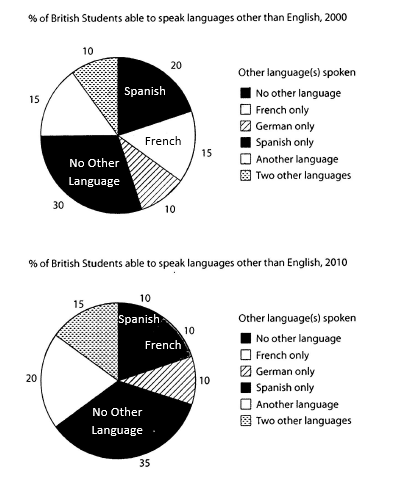
The charts below show the proportions of British students at one university in England who were able to speak other languages in addition to English, in 2000 and 2010
Summarise the information by selecting and reporting the main features, and make comparisons where relevant.
Student answer (Band 6.5)
The two pie charts compare the percentages of British students at one university in England who could speak other languages besides English, in the years 2000 and 2010.
Overall, in both years the largest proportion of students could not speak any other languages other than English. The percentages of students who spoke another language and two other languages showed an upward trend, while French and Spanish experienced an overall decline. However, the number of German speaking students remained constant in both years.
In 2000, only English speaking students was the largest category among others, which rose from 30% to 35% in 2010. The proportions of students who could speak another language and two other languages were 15% and 10% in 2000, respectively, and both experienced a growth of 5%, became 20% and 15% at the end of the period.
Spanish, on the other hand, was the second largest category, which fell by half, from 20% in 2000 to 10% in 2010. The percentage of French speaking students accounted for 15% of total students in 2000, and this figure decreased to 10% in 2010. By contrast, the proportion of students who spoke German remained same in both years at 10%.
AI examiner evaluation
| Criterion | Band |
|---|---|
| Task Achievement / Task Response | 7.0 |
| Coherence and Cohesion | 7.0 |
| Lexical Resource | 6.5 |
| Grammatical Range and Accuracy | 6.0 |
| Overall | 6.5 |
Task Achievement / Task Response: Band 7.0
You give a clear overview of the main changes, accurately identifying the largest category in both years, the increases in “another language” and “two other languages,” the declines in Spanish and French, and the unchanged German figure. The numerical comparisons are also well selected: for example, Spanish falls from 20% to 10%, while no other language rises from 30% to 35%. This addresses the task clearly and supports the overview with relevant data. One point to refine is “only English speaking students”: the chart category is students with “no other language,” so describe this as students who spoke only English rather than implying a separate speaking group. Also, “the number” of German speakers refers to a count, whereas the chart reports proportions.
Coherence and Cohesion: Band 7.0
The response is organised effectively into an introduction, an overview, and two detail paragraphs. The progression from the overall pattern to increases and then declines is easy to follow, and comparisons are grouped sensibly. Linking expressions such as “Overall,” “On the other hand,” and “By contrast” help signal relationships between the figures. Cohesion is generally clear, though some references are slightly awkward: “which rose from 30% to 35%” follows “category,” and “which fell by half” follows “Spanish,” making the referents less precise than they could be. Use direct constructions such as “This share rose…” or “The proportion for Spanish fell…” to make the links between categories and figures consistently clear.
Lexical Resource: Band 6.5
You use a suitable range of chart-reporting vocabulary, including “proportions,” “accounted for,” “decline,” “remained constant,” and “fell by half.” These choices allow you to describe the main trends with some flexibility, and the meaning remains clear throughout. To show more precise control, avoid less natural combinations such as “experienced a growth of 5%” and “the number of German speaking students” when the data show percentages. “Only English speaking students” is also an imprecise label for the chart category. More accurate phrasing for categories and percentage-point changes would strengthen the report’s formal, data-focused style.
Grammatical Range and Accuracy: Band 6.0
You use a mix of simple and complex sentences, including subordinate clauses and contrast structures, and most of the information is readily understood. Some grammatical errors remain. In “only English speaking students was the largest category,” the plural subject requires “were,” and the category itself would be clearer as “students who spoke only English.” The phrase “both experienced a growth of 5%, became 20% and 15%” has an unclear clause connection; write, for example, “both rose by five percentage points, reaching 20% and 15%.” “Remained same” also needs an article: “remained the same.” These are generally local errors, but checking agreement, articles, and sentence connections would improve accuracy.
See this exact question answered at other band scores. The same prompt compared across bands.
Browse more IELTS Writing model answers or get your own writing scored by the same AI examiner.