Band 5.0 IELTS Writing Task 1 Model Answer
Overall Band Score: 5.0 · Cambridge IELTS 11 · 2026-11-13
IELTS Writing Task 1 question
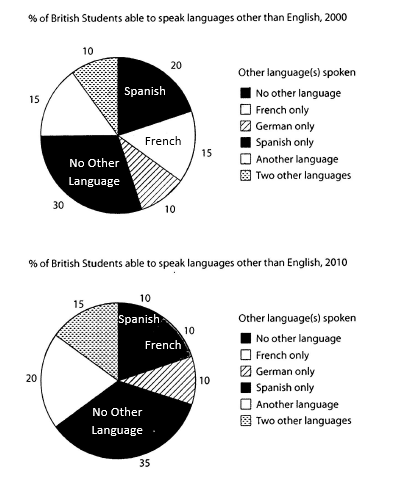
The charts below show the proportions of British students at one university in England who were able to speak other languages in addition to English, in 2000 and 2010
Summarise the information by selecting and reporting the main features, and make comparisons where relevant.
Student answer (Band 5.0)
The chart presents the percentage of university students in England who can speak foriegn languages other than English, in 2000 and 2010.
In 2000, British student were able speak 20% Spanish and 15% French language, these two foriengn languages were the highly spoken one by students. However students had spoken German and two other language approximately 10%. No other lanuage percenatge is 30% and other language is 15%.
In 2010 there is a slide diffrence in the percentage of languages spoken by british students. Spanish, German and French language percentage was 10% only. Percenatge was increased in 2010 for Another language which was 20% and 15% for Two other languages. The percantage for no other lanuage is 35%.
The sum of lanuages spoken by Bristish students has a slide decrease in Spanish, German and French language and increase in Another language in 2010. On the other hand there is a increase in Spanish and German which is around 15-20%. German language was less spoken and ther percenatge is 10% only Another and Two other language has the percentage of 15-10% in 2010.
AI examiner evaluation
| Criterion | Band |
|---|---|
| Task Achievement / Task Response | 5.0 |
| Coherence and Cohesion | 5.0 |
| Lexical Resource | 5.0 |
| Grammatical Range and Accuracy | 5.0 |
| Overall | 5.0 |
Task Achievement / Task Response: Band 5.0
You report several accurate figures, including Spanish at 20% and French at 15% in 2000, and the rise in “No other language” to 35% in 2010. However, the response only partially fulfils the task because it lacks a clear, accurate overview of the main pattern across both charts. The final paragraph is especially confusing: it says Spanish and German increased, although Spanish fell from 20% to 10% and German stayed at 10%; it also repeats figures in a way that conflicts with the earlier account. State the overall changes clearly—for example, the share speaking no other language rose, while Spanish declined—and support this with selected comparisons.
Coherence and Cohesion: Band 5.0
The response has a basic structure, moving from 2000 to 2010 and then attempting a comparison, so the reader can identify the broad topic of each paragraph. However, there is no clear overall progression: the final paragraph repeats earlier information and introduces contradictory claims, such as saying Spanish increased after reporting that it fell. Linking words such as “However” and “On the other hand” are used, but they do not always express the relationship between the ideas accurately. Improve the organisation by giving a concise overview first, then grouping the figures by increases and decreases. Avoid repeating data and use clear references so each comparison is easy to follow.
Lexical Resource: Band 5.0
You use some relevant chart vocabulary, including “percentage,” “increased,” “decrease,” and “spoken,” and the language categories are generally recognisable. However, the range is limited and several word-choice, form, and spelling errors make parts of the report difficult to read, such as “slide diffrence,” “highly spoken,” and “sum of lanuages spoken.” Repeated use of “percentage” and “language” also makes the writing less precise. Choose standard expressions for describing chart data, such as “the proportion of students speaking Spanish fell,” and check spelling carefully. Distinguish “another language” from “two other languages” consistently, since these are separate categories in the charts.
Grammatical Range and Accuracy: Band 5.0
The response attempts both simple and longer sentences, but the range is limited and errors occur frequently, sometimes making relationships between figures unclear. Examples include “British student were able speak” and “Spanish, German and French language percentage was 10% only,” where agreement and sentence construction are faulty. Articles and plural forms are also often missing or inconsistent, as in “two other language” and “No other lanuage percenatge is 30%.” The final sentence is difficult to parse because several clauses and figures are joined without clear punctuation. Practise accurate subject–verb agreement, articles, and plural nouns, and use shorter, complete sentences before attempting more complex comparisons.
See this exact question answered at other band scores. The same prompt compared across bands.
Browse more IELTS Writing model answers or get your own writing scored by the same AI examiner.