Band 5.5 IELTS Writing Task 1 Model Answer
Overall Band Score: 5.5 · Cambridge IELTS 11 · 2026-11-14
IELTS Writing Task 1 question
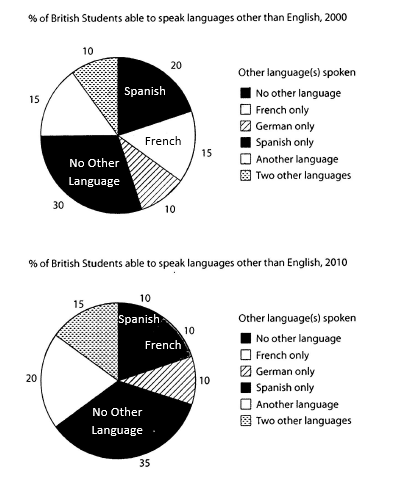
The charts below show the proportions of British students at one university in England who were able to speak other languages in addition to English, in 2000 and 2010
Summarise the information by selecting and reporting the main features, and make comparisons where relevant.
Student answer (Band 5.5)
The given Bar charts compare the percentage of a University's British students who can speak English and some other languages in 2000 and 2010.
Overall, It is depicted from the figures that in 2000, only English proficient students is 30 percent whereas in 2010 it is 35 Percent. In addition it is cleared that same percentage of students are able to speak German and two other languages in 2000 while in 2010 same percentage of students can speak Spanish and French and German.
On the otherhand, in 2000 the students are able to speak French only is 15 percent , German only 10 percent, Spanish only 20 percent, another language 15 percent and two other languages 10 percent respectively. It is also noticed from the figure 2 that in 2010, the students are able to speak French only is 10 percent , German only 10 percent, Spanish only 10 percent, another language 20 percent and two other languages 15 percent subsequently.
AI examiner evaluation
| Criterion | Band |
|---|---|
| Task Achievement / Task Response | 5.0 |
| Coherence and Cohesion | 6.0 |
| Lexical Resource | 5.5 |
| Grammatical Range and Accuracy | 5.0 |
| Overall | 5.5 |
Task Achievement / Task Response: Band 5.0
You report several relevant figures accurately, including French (15% to 10%), German (10% in both years), and the rise in “another language” (15% to 20%). However, the overview is unclear and partly misinterprets the categories: “English proficient students” refers to students speaking no other language, not English proficiency, and the claim that the same percentage spoke German and two other languages in 2000 is inaccurate (10% for each is correct, but the comparison is not clearly expressed). The overview also misses the main shifts: Spanish fell from 20% to 10%, while no other language rose from 30% to 35%. A clearer summary of these key changes, followed by accurate supporting details, would make the response more complete.
Coherence and Cohesion: Band 6.0
The response has a recognisable structure: an introduction, an overview, and a paragraph giving figures for each year. This helps the reader follow the broad comparison. However, progression is weakened by unclear references such as “it” and “same percentage,” which make it difficult to identify the categories being compared. The transition “On the otherhand” does not clearly signal the move from the overview to detailed data, and “subsequently” is not an effective way to close the list. Grouping the figures by the most important increases, decreases, and unchanged categories would create a more logical comparison. Use linking expressions selectively and make each reference explicit.
Lexical Resource: Band 5.5
You use some task-relevant vocabulary, including “percentage,” “speak,” and “respectively,” and the category labels generally allow the reader to understand the data. However, the range is limited and several expressions are inaccurate or awkward, such as “English proficient students” for students who speak no other language and “it is cleared.” Repeated use of “students are able to speak” also makes the description less concise. Choose precise chart language and vary reporting verbs, for example, “accounted for,” “rose,” and “fell.” Check spelling and spacing in phrases such as “On the otherhand,” and use the chart’s category names consistently so that the comparisons remain clear.
Grammatical Range and Accuracy: Band 5.0
The response attempts both simple statements and longer sentences, but control is inconsistent. Errors in agreement and sentence construction appear in phrases such as “students is 30 percent” and “the students are able to speak French only is 15 percent.” The overview sentence beginning “in 2000, only…” is also difficult to follow because its structure does not clearly connect the subject and the figure. Capitalisation is inconsistent, as in “Overall, It” and “35 Percent,” and commas are sometimes separated from the preceding word. Practise concise comparison patterns such as “The proportion speaking French fell from 15% to 10%” and “German remained unchanged at 10%.” More accurate subject–verb agreement and sentence boundaries would improve clarity.
See this exact question answered at other band scores. The same prompt compared across bands.
Browse more IELTS Writing model answers or get your own writing scored by the same AI examiner.