Band 5.0 IELTS Writing Task 1 Model Answer
Overall Band Score: 5.0 · Cambridge IELTS 11 · 2026-11-14
IELTS Writing Task 1 question
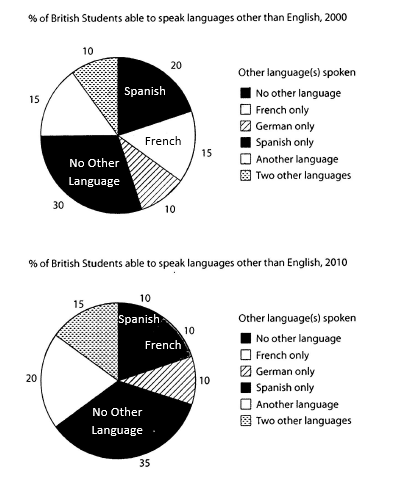
The charts below show the proportions of British students at one university in England who were able to speak other languages in addition to English, in 2000 and 2010
Summarise the information by selecting and reporting the main features, and make comparisons where relevant.
Student answer (Band 5.0)
The below chart illustrates the proportions of British students at one university in United Kingdom who can talk other languages rather than English, in year 2000 and 2010.
Overall, In 2000 the percentage of no other language spoken by British student other than English is highest and the least percentage notice by two other languages. whereas the percentage of other language spoken other than English in the year of 2010 is much higher.
To begin with, the languages spoken similar are German and two other languages in the year of 2000 with percentage 10%. In addition the French and Another language also goes same with there percentage at 15%. However, the Spanish language shows gradually high with the percentage of 20% the British students speak other than English in year of 2000. nut the most language speak by the British students in the year 2000 is No other languages with 30% other than English.
On the other hand, In the year of 2010 the languages talk more by the British student other than English are Spanish,German only and French with the percentage of 10%. these are the lowest percentage speak languages by the British students. Than the languages those were speak most in the year of 2010 are No other languages with the percentage of 35%.
AI examiner evaluation
| Criterion | Band |
|---|---|
| Task Achievement / Task Response | 5.0 |
| Coherence and Cohesion | 5.5 |
| Lexical Resource | 5.0 |
| Grammatical Range and Accuracy | 5.0 |
| Overall | 5.0 |
Task Achievement / Task Response: Band 5.0
You identify the two years and report several figures accurately, including 30% for no other language in 2000, 35% in 2010, and 10% for German in both years. However, the overview is unclear and partly inaccurate: saying that the proportion speaking another language in 2010 was “much higher” overlooks that the no-other-language group also increased. The main shift is that Spanish fell from 20% to 10%, while “another language” rose from 15% to 20% and two other languages from 10% to 15%. These changes are not reported, and the 2010 figures for the latter two categories are omitted. Also, “the least percentage” in 2000 is not uniquely two languages, since German is also 10%. Select and compare the key changes more clearly.
Coherence and Cohesion: Band 5.5
The response has a recognisable structure: an introduction, an overview, and separate paragraphs for 2000 and 2010. This gives the reader a basic route through the information. However, progression within the paragraphs is uneven, and some comparisons are difficult to follow. For example, the overview moves from the highest and lowest categories to the vague claim that the 2010 proportion is “much higher,” without specifying which category is meant. Linking expressions such as “To begin with,” “In addition,” and “On the other hand” are used, but they do not always clarify the relationship between the figures. Group the data by meaningful changes across the two years, and use clear references such as “this share” only when the category is unmistakable.
Lexical Resource: Band 5.0
You use some relevant chart vocabulary, including “percentage,” “proportions,” and “highest,” so the topic is generally understandable. However, the range is limited and several phrases are repeated or imprecise, such as “languages talk” and “languages spoken … other than English.” Some word choices make the intended comparison difficult to interpret: “the languages spoken similar” does not clearly express that two categories had equal shares, while “gradually high” is not suitable for a single percentage comparison. There are also spelling and form errors, including “nut” for “but” and “there” for “their.” Build a more precise set of terms for describing shares and change, and check spelling and collocations before submitting.
Grammatical Range and Accuracy: Band 5.0
The response attempts a few longer structures, including “whereas” and “with the percentage of,” but most sentences rely on simple patterns, and errors are frequent enough to affect clarity. For example, “the percentage of no other language spoken by British student … is highest” has problems with articles, number agreement, and sentence construction. In “the French and Another language also goes same,” the subject is plural but the verb is singular, and the structure is incomplete. Capitalisation and punctuation are also inconsistent, as in “Overall, In 2000” and “Spanish,German.” Practise accurate comparisons using patterns such as “X accounted for …, compared with …,” and check subject–verb agreement, articles, and sentence boundaries.
See this exact question answered at other band scores. The same prompt compared across bands.
Browse more IELTS Writing model answers or get your own writing scored by the same AI examiner.