Band 6.0 IELTS Writing Task 1 Model Answer
Overall Band Score: 6.0 · Cambridge IELTS 11 · 2026-11-14
IELTS Writing Task 1 question
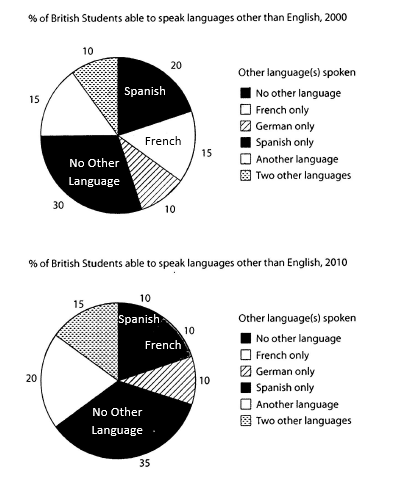
The charts below show the proportions of British students at one university in England who were able to speak other languages in addition to English, in 2000 and 2010
Summarise the information by selecting and reporting the main features, and make comparisons where relevant.
Student answer (Band 6.0)
The pie charts illustrate the percentage of british learners who can speak several languages than English at one english university in 2000 and 2010.
Overall, Students who could not speak more than one laguage showed the highest part in both years, while Spanish and French were the second dominated langue after English, before the steady decerase in the last year.
In 2000, students who were not able to talk another langue than their native one recorded the highest part with 30% , followed by Spanish with 20%, French and another language came third with quarter for both, moreover German and two other languages came last with only 10%.
By 2010, student who could not talk various languages keept first with an addition of 5% reaching 35%, furthermore, Spanish and French speakers showed a slight decears of 10% for both, contrary to Other langues and Two other langues which almost doubled with 20% and 15% respectively, finnaly, German stayed last with only 10%.
AI examiner evaluation
| Criterion | Band |
|---|---|
| Task Achievement / Task Response | 6.5 |
| Coherence and Cohesion | 6.5 |
| Lexical Resource | 5.0 |
| Grammatical Range and Accuracy | 5.5 |
| Overall | 6.0 |
Task Achievement / Task Response: Band 6.5
You identify the main overall pattern: the “No Other Language” group is largest in both years, while Spanish falls and the “Another language” and “Two other languages” groups rise. Most figures are reported accurately, including 30% and 35% for no other language and the 2010 values. However, there is a notable misreading in the 2000 account: French is 15%, not a quarter, and “another language” is also 15%, so they did not each make up 25%. The overview’s claim that Spanish and French were the second most common categories is also imprecise, since Spanish was second in 2000 but French was tied with another language. A clearer overview and more precise comparisons would strengthen the response further.
Coherence and Cohesion: Band 6.5
The response has a clear four-part structure: an introduction, an overview, and a paragraph for each year. This makes the information easy to follow, and the chronological organisation is appropriate. You also use linking expressions such as “Overall,” “followed by,” and “By 2010” to signal relationships between points. However, the long final sentence strings together several comparisons with “furthermore,” “contrary to,” and “finally,” making the progression somewhat mechanical and harder to process. Some references, such as “the last year,” are less direct than naming 2010. To improve, separate the 2010 comparisons into shorter sentences and use linking words only where they clarify a genuine contrast or addition.
Lexical Resource: Band 5.0
You use some relevant chart vocabulary, including “percentage,” “followed by,” “recorded,” and “reaching,” and the reader can generally understand the intended comparisons. However, the range and control of word choice are limited by repeated use of “part” and “talk,” as well as inaccurate or unnatural phrases such as “second dominated langue,” “with quarter for both,” and “showed a slight decears of 10%.” Spelling errors, including “british,” “laguage,” “decerase,” and “finnaly,” are noticeable and reduce clarity. Aim for precise terms such as “proportion,” “accounted for,” and “fell by ten percentage points,” and proofread carefully for spelling and word forms.
Grammatical Range and Accuracy: Band 5.5
You attempt a mix of simple and more complex sentence forms, including a contrast in “while Spanish and French…” and a sequence of comparisons in the final paragraph. The main message remains understandable, but some grammatical errors affect clarity. For example, “students who were not able to talk another langue than their native one recorded the highest part” has an awkward clause structure, while “Spanish and French speakers showed a slight decears of 10% for both” lacks a clear grammatical construction for describing a fall. There are also inconsistent capital letters after sentence openings and extra spaces before punctuation. Practise accurate comparative structures, such as “the proportion fell from 20% to 10%,” and check sentence boundaries and punctuation.
See this exact question answered at other band scores. The same prompt compared across bands.
Browse more IELTS Writing model answers or get your own writing scored by the same AI examiner.