Band 4.5 IELTS Writing Task 1 Model Answer
Overall Band Score: 4.5 · Cambridge IELTS 11 · 2026-11-15
IELTS Writing Task 1 question
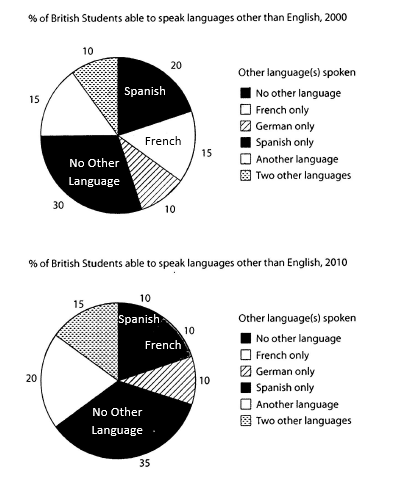
The charts below show the proportions of British students at one university in England who were able to speak other languages in addition to English, in 2000 and 2010
Summarise the information by selecting and reporting the main features, and make comparisons where relevant.
Student answer (Band 4.5)
research in a university of england show that how many students were able to speak other language in addition to british as the chart shows thar only 20 percent of the students can spoke spanish .and only 10 percent of the students can spoke german only .the following informations shows that there are 30 percent student wo can spoke english and can knows how to talk in other langusage and 10 percent of the students can spoke two other languages and 15 percent can spoke the french only and 15 percent can speak another language over alll the chart shows that in that univesity the majority if the students can spoke only the english and in 2nd rank the spanish after that in third rank the students can spoke the french and another language in that university the students who are in the minority can spoke the german and two other languages in university the first ranked are english speaker
AI examiner evaluation
| Criterion | Band |
|---|---|
| Task Achievement / Task Response | 4.0 |
| Coherence and Cohesion | 4.0 |
| Lexical Resource | 4.5 |
| Grammatical Range and Accuracy | 4.5 |
| Overall | 4.5 |
Task Achievement / Task Response: Band 4.0
You identify several relevant categories and figures from 2000, including Spanish at 20%, German at 10%, French at 15%, and two other languages at 10%. You also attempt an overall statement that English-only students were the largest group. However, the response reports almost entirely the 2000 chart and does not compare it with 2010, where the no-other-language group rose to 35%, Spanish and French fell, and the other-language categories increased or stayed level. Some descriptions are also inaccurate: the 30% figure is students speaking no other language, not students who speak English and another language. The overview and selection of key features are therefore incomplete and only minimally address the two-chart task. Compare the years explicitly and report the main changes accurately.
Coherence and Cohesion: Band 4.0
The response contains a few recognisable stages: it introduces the charts, lists several categories, and ends with a broad statement about the largest and smallest groups. This gives the reader some sense of the intended topic. However, the information is presented as one long, loosely connected sequence rather than in clearly organised paragraphs, and the progression between figures and conclusions is difficult to follow. Repeated links such as “and,” “after that,” and “in third rank” do not establish precise relationships, while the final ranking is confusing because it does not clearly distinguish English-only students from those speaking another language. Group the response into an introduction, an overview, and a comparison of the two years, using clear references to each chart.
Lexical Resource: Band 4.5
You use some task-relevant vocabulary, including “percent,” “majority,” “minority,” and language labels such as “Spanish” and “French.” These choices show that you can convey the basic subject of the charts. However, the vocabulary is highly repetitive, especially the repeated phrase “can spoke,” and several word choices or forms make the meaning unclear, such as “the following informations” and “the first ranked are english speaker.” Spelling errors, including “langusage” and “univesity,” also reduce clarity. Build a more precise range for describing charts, such as “accounted for,” “proportion,” “increased,” and “declined,” and use accurate category labels such as “students who spoke no other language.”
Grammatical Range and Accuracy: Band 4.5
There is an attempt to connect ideas in longer sentences, for example through “and” and “after that,” but most of the response relies on a narrow, repetitive sentence pattern. Verb forms are frequently inaccurate: “students can spoke” should be “students could speak” or “students spoke,” and “can knows” should be “know.” Agreement and sentence construction are also weak in phrases such as “30 percent student” and “the first ranked are.” Missing or misplaced punctuation makes the long sequence harder to interpret. These recurring errors sometimes obscure the intended relationships between the figures. Practise writing short, complete comparison sentences first, then combine them with accurate clauses using forms such as “while” and “whereas.”
See this exact question answered at other band scores. The same prompt compared across bands.
Browse more IELTS Writing model answers or get your own writing scored by the same AI examiner.