Band 5.5 IELTS Writing Task 1 Model Answer
Overall Band Score: 5.5 · Cambridge IELTS 11 · 2026-11-15
IELTS Writing Task 1 question
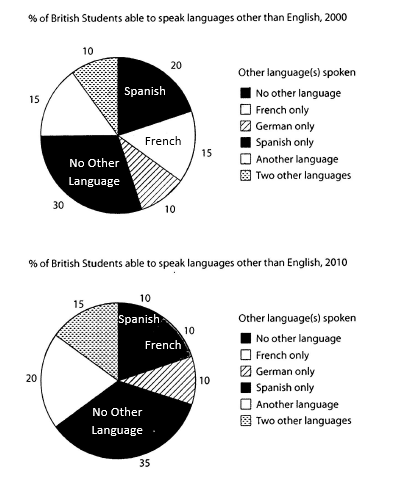
The charts below show the proportions of British students at one university in England who were able to speak other languages in addition to English, in 2000 and 2010
Summarise the information by selecting and reporting the main features, and make comparisons where relevant.
Student answer (Band 5.5)
The two charts illustrate the proportions of british youngsters at one university in the country England who were able to speak other languages in addition to english between 2000 and 2010.
Overall, it is clear that in both year the most dominants source is no other language, while the second rank come at Spanish which is speaking more language. However, in both year two other language and german have fewest ratio in speaking in english.
To commence, in 2000 the british pupils speaks more no other language accounted for 30%. Additionally, the French and another language halve been similar ratio at 15%. Moreover, in comparison to two other language and german ammounted for 10% but the Spanish double the amount of ratio approximately 20%.
On the other hand, percentage which flucutation in the year 2010 in british students that the no other language rose marginally from 30% to 35%. In addition, the Spanish and French which come at same level 10%. Furthermore, two other language rise gradually from 10% to 15% as well as the another language also climb extra 5%. It is noticeable that the german remain stable in both year approximate 10%.
AI examiner evaluation
| Criterion | Band |
|---|---|
| Task Achievement / Task Response | 6.0 |
| Coherence and Cohesion | 6.5 |
| Lexical Resource | 5.0 |
| Grammatical Range and Accuracy | 5.0 |
| Overall | 5.5 |
Task Achievement / Task Response: Band 6.0
You cover both years and report several key figures accurately: no other language rises from 30% to 35%, Spanish falls from 20% to 10%, and German remains at 10%. The overview also identifies the largest category in both years. However, the claim that Spanish is the second-largest category in both years is inaccurate: in 2010, “another language” is 20%, ahead of Spanish and French at 10% each. The statement that two other languages and German have the lowest proportions is also only true in 2000; by 2010, German and French and Spanish share the lower figure. The main features are relevant, but these comparisons need more precise reporting and development.
Coherence and Cohesion: Band 6.5
The response has a clear overall structure: an introduction, an overview, and separate paragraphs for 2000 and 2010. This makes the information easy to follow, and the contrastive transition “On the other hand” signals the move to the later year. You also use linking expressions such as “Additionally” and “Furthermore.” However, some connections feel mechanical, and the overview’s comparisons are not consistently clear—for example, “the second rank come at Spanish” does not clearly explain the ranking. The 2010 paragraph lists changes but could group increases, decreases, and stable figures more logically. More precise referencing and less repetitive sequencing would make the progression smoother.
Lexical Resource: Band 5.0
You use some task-relevant vocabulary, including “proportions,” “accounted for,” “rose,” and “remain stable,” which helps communicate the chart data. However, word choice and collocation are often inaccurate or unnatural, as in “most dominants source,” “speaking more language,” “fewest ratio,” and “climb extra 5%.” These expressions sometimes make the intended comparison difficult to understand. There are also spelling and word-form errors, such as “flucutation,” “ammounted,” and “halve been.” Aim for accurate, conventional chart language and check spelling and forms carefully. For example, describe a category as having the “largest proportion,” and say a figure “increased by five percentage points.”
Grammatical Range and Accuracy: Band 5.0
You attempt a mixture of simple statements and longer sentences, and the reader can generally identify the figures being compared. However, grammatical control is uneven, particularly in agreement, verb forms, articles, and sentence construction. Examples include “in both year,” “the second rank come,” and “the british pupils speaks”; these should use plural forms and appropriate verb agreement. The sentence beginning “percentage which flucutation in the year 2010” is difficult to parse because its clause structure is incomplete. Some longer sentences also combine several comparisons without clear grammatical links. Practise building accurate comparison sentences, such as “The proportion speaking another language increased from 15% to 20%,” and check agreement and tense throughout.
See this exact question answered at other band scores. The same prompt compared across bands.
Browse more IELTS Writing model answers or get your own writing scored by the same AI examiner.