Band 5.5 IELTS Writing Task 1 Model Answer
Overall Band Score: 5.5 · Cambridge IELTS 11 · 2026-11-15
IELTS Writing Task 1 question
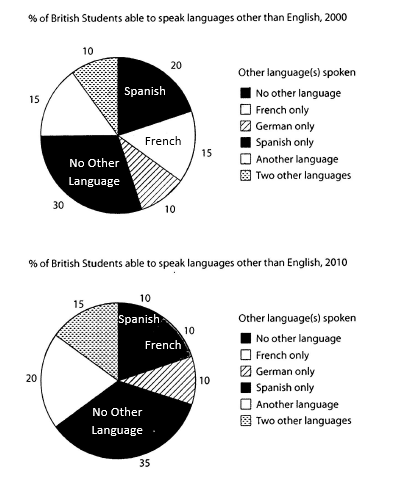
The charts below show the proportions of British students at one university in England who were able to speak other languages in addition to English, in 2000 and 2010
Summarise the information by selecting and reporting the main features, and make comparisons where relevant.
Student answer (Band 5.5)
The pie charts illustrate the percentages of British students able to speak languages other than English at a particular university in England, in 2000 and 2010.
Overall, the proportion students who were able to speak languages changed over time. While, the figure for German language did not change in the both given years.
In 2000, 20% of british students were able to speak Spanish, however in 2010 the proportation declined by 10%. Morover, the figure for France was 15% in 2000, and the number decreased by 5% in 2010. Whereas, the perrcentage for German language remained the same in both years at 10%.
Next, about 30% of students from England could not speak any other language, the number increased by 5% in the next decade. Furthermore, 15% of british students could talk in another language, and it rose by 5% in 2010.
AI examiner evaluation
| Criterion | Band |
|---|---|
| Task Achievement / Task Response | 5.0 |
| Coherence and Cohesion | 6.0 |
| Lexical Resource | 5.5 |
| Grammatical Range and Accuracy | 5.5 |
| Overall | 5.5 |
Task Achievement / Task Response: Band 5.0
You identify the two years and report several accurate comparisons: Spanish falls from 20% to 10%, French from 15% to 10%, German stays at 10%, and the no-other-language group rises from 30% to 35%. However, the overview is vague: “the proportion students who were able to speak languages changed” does not clearly summarise the main pattern, and it omits the increase in students speaking two other languages. The final category is also not reported, so the account is only partial and some key information is under-developed. The response is 142 words, below the required 150; use the remaining space to give a clearer overview and cover the two-other-languages figures.
Coherence and Cohesion: Band 6.0
The response has a clear basic structure: an introduction, an overview, and two paragraphs presenting comparisons. The sequence from Spanish, French and German to the no-other-language and another-language groups is generally easy to follow. Linking expressions such as “Overall,” “Next,” and “Furthermore” help signal movement between points. However, some transitions are awkward or mechanical: “however” and “Whereas” are used in ways that interrupt the flow, and “Next” does not clearly show how the final paragraph relates to the earlier comparisons. Group related categories more deliberately and use clear references, for example, compare all increases together and all decreases together. This would make the progression more cohesive without changing the straightforward organisation.
Lexical Resource: Band 5.5
You use enough topic vocabulary to communicate the main comparisons, including “percentages,” “declined,” “remained the same,” and “increased.” There is some variation in how you describe changes, but several word-choice and spelling problems reduce precision: “proportation” and “perrcentage” are misspelled, “France” should be “French,” and “could talk in another language” is an unnatural collocation for this chart. “British” is also incorrectly lower-case in places. Aim for accurate, consistent terms such as “the proportion of students,” “French,” and “could speak another language.” More precise vocabulary would help you describe the categories and changes clearly, while avoiding awkward alternatives such as “the number” when referring to a percentage.
Grammatical Range and Accuracy: Band 5.5
You attempt a mix of simple and more complex sentences, including contrast clauses with “While” and “however,” and most of the intended comparisons remain understandable. Some grammatical errors are noticeable, though. The overview says “the proportion students,” missing “of,” and “in the both given years” has an unnecessary article and an awkward phrase. The sentence beginning “While” is not properly connected to a main clause, and “Whereas” is also used as a fragment rather than as part of a complete sentence. There is some control of past-tense reporting, but these sentence-boundary and article errors limit accuracy. Practise joining contrast clauses to complete main clauses and check articles and prepositions in phrases such as “in both years.”
See this exact question answered at other band scores. The same prompt compared across bands.
Browse more IELTS Writing model answers or get your own writing scored by the same AI examiner.