Band 5.0 IELTS Writing Task 1 Model Answer
Overall Band Score: 5.0 · Cambridge IELTS 11 · 2026-11-15
IELTS Writing Task 1 question
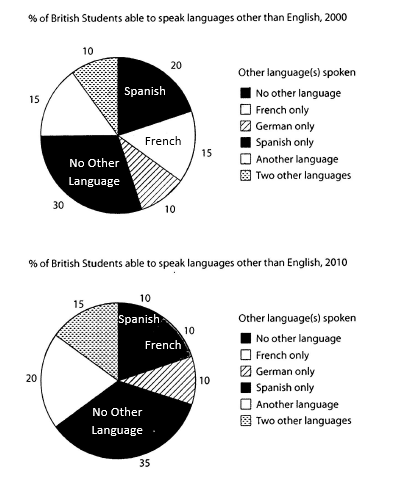
The charts below show the proportions of British students at one university in England who were able to speak other languages in addition to English, in 2000 and 2010
Summarise the information by selecting and reporting the main features, and make comparisons where relevant.
Student answer (Band 5.0)
so here i am going to describe the percentage of british students were able in between 2000 and 2010
so at first 2000
british students cannot speak any other languages like french or another languages
20% of the students could speak spanish language and its soo good
10% of the students could speak german language
and 10% of the students can speak any other two languages
30 % of the public cannot speak any other languages
NOW am going to show the graph of students in british that are able to speak other languages than 2010
british public coudnt speak any anyother languages and its ratio isa 35%
and at the other hand 20% of the individuals could speak french languages.
10% of british public could speak german languages.
there is a big difference to see that peoples who speaks spanish language their ratio is now tiny less than 2000 its now only 10%
on trhe other hand british publish could speak french language only by 10% percent.
they can speak any other 2 languages just by 15% percent
AI examiner evaluation
| Criterion | Band |
|---|---|
| Task Achievement / Task Response | 4.5 |
| Coherence and Cohesion | 5.0 |
| Lexical Resource | 5.0 |
| Grammatical Range and Accuracy | 4.5 |
| Overall | 5.0 |
Task Achievement / Task Response: Band 4.5
You identify several relevant categories and report some correct figures, including Spanish at 20% in 2000 and 10% in 2010, German at 10% in both years, and no other language at 30% and 35%. However, the account is only partial and contains important inaccuracies: in 2010, 20% spoke another language, not French, while French was 10%. The 2000 figures for French and another language are also omitted, and the opening claim that students “cannot speak any other languages” conflicts with the categories that follow. There is no clear overview of the main changes. To improve, summarise the overall pattern first, then compare the key categories accurately and avoid unsupported comments such as “its soo good.”
Coherence and Cohesion: Band 5.0
The response follows a basic time sequence, first discussing 2000 and then 2010, and this gives the reader some sense of organisation. Simple links such as “at first” and “on the other hand” also show an attempt to connect ideas. However, the progression is not clear throughout: the 2010 section repeats the French figure, and the opening statement does not lead smoothly into the data. There are no distinct overview and detail paragraphs, while repeated sentence openings such as “10% of the students” make the account feel list-like. Group the information into an introduction, an overview, and one or two comparison paragraphs, using references such as “this proportion” only when the category is clear.
Lexical Resource: Band 5.0
You use enough basic vocabulary to identify the topic and several language categories, including “percentage,” “speak,” “Spanish,” and “German.” Some attempts to vary expression, such as “ratio” and “individuals,” are evident. However, the range is limited and several choices are inaccurate or informal for an academic report: “its soo good,” “tiny less,” and “british publish” do not communicate the data appropriately. Repeated use of “could speak” and “language” also makes the description monotonous. Use precise chart-reporting phrases and check spelling and collocation; for example, describe a proportion as “increased” or “fell,” rather than calling it “tiny less.”
Grammatical Range and Accuracy: Band 4.5
Most of the response uses short, simple statements, and the reader can usually identify the intended category and percentage. However, grammatical control is inconsistent, with frequent errors that sometimes make relationships unclear. The opening, “the percentage of british students were able,” lacks a clear grammatical structure, and “students cannot speak” does not fit the past-time description. Other examples include “students in british that are able” and “their ratio is now tiny less than 2000,” where sentence structure and comparison forms are faulty. Capitalisation and punctuation are also inconsistent, with sentence starts often unmarked. Practise accurate past-tense reporting and build complete comparison sentences, such as “The proportion able to speak Spanish fell from 20% to 10%.”
See this exact question answered at other band scores. The same prompt compared across bands.
Browse more IELTS Writing model answers or get your own writing scored by the same AI examiner.