Band 5.0 IELTS Writing Task 1 Model Answer
Overall Band Score: 5.0 · Cambridge IELTS 11 · 2026-11-16
IELTS Writing Task 1 question
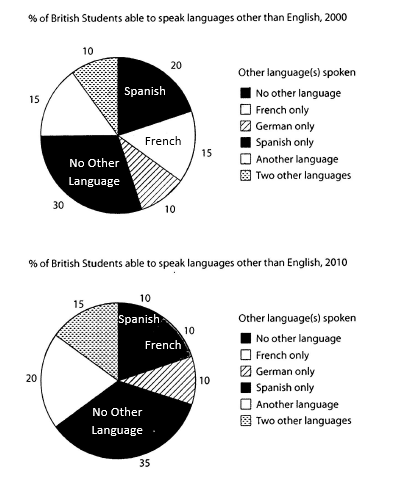
The charts below show the proportions of British students at one university in England who were able to speak other languages in addition to English, in 2000 and 2010
Summarise the information by selecting and reporting the main features, and make comparisons where relevant.
Student answer (Band 5.0)
This chart distributes different British students in a single university who could speak different languages including English in the year 2000 and 2010.
Overall it can be seen that students speaking no other language besides English slightly increased where as Spanish became less common while the proportion two other languages and no other language rose noticeably and German remain unchanged.
In year 2010 Spanish has the most highest distribution among the additional languages of 20% where as french was spoken by 10% and German 15%. Furthermore two other languages and 15% other languages only at last remaining 30% spoke no other language besides English.
On the other hand in 2010 it can be seen that both French and Spanish languages saw a decrease taking their proportion to 10% where as German remained unchanged at 10%. In addition the category of no other language increased to 15% and another language to 20% Furthermore no other languages besides English dominated the chart being at 35%.
AI examiner evaluation
| Criterion | Band |
|---|---|
| Task Achievement / Task Response | 4.5 |
| Coherence and Cohesion | 4.5 |
| Lexical Resource | 5.5 |
| Grammatical Range and Accuracy | 5.0 |
| Overall | 5.0 |
Task Achievement / Task Response: Band 4.5
The response attempts an overview and compares both years, but several key figures are misreported, which makes the account unreliable. For 2000, you say Spanish was the most common additional language at 20%, but this is presented under the paragraph beginning “In year 2010”; the 2010 Spanish figure is actually 10%. You also give French as 10% and German as 15% in that paragraph, whereas the 2000 figures are French 15% and German 10%. In the 2010 account, “no other language increased to 15%” confuses the 5-point rise with the final value of 35%. The overview identifies some real trends, but it also says Spanish became less common without clearly anchoring the comparison. Check each figure and year, then select the main changes accurately.
Coherence and Cohesion: Band 4.5
There is an attempt to organise the response into an introduction, an overview and year-based details, and phrases such as “Overall” and “On the other hand” signal relationships. However, the progression is difficult to follow because the paragraph introduced as “In year 2010” reports mainly 2000 data, while the next paragraph returns to 2010. This makes the comparison confusing. Some linking is also mechanical or unclear: “where as” is repeated, and “Furthermore” joins details without showing how they relate. The final sentence repeats the point that no other language was the largest category. A clearer sequence—overview, then accurate figures for 2000 and 2010, with direct comparisons—would make the information easier to track.
Lexical Resource: Band 5.5
You use some relevant chart vocabulary, including “proportion,” “distribution,” “category,” “increased,” and “remained unchanged,” so the topic is generally recognisable. However, several choices are awkward or imprecise, such as “This chart distributes different British students” and “the most highest distribution.” “Languages including English” also misrepresents the chart, which concerns languages in addition to English. Repetition of “where as” and “no other language” limits flexibility, while “other languages only” is unclear as a category label. Aim for precise reporting verbs and natural collocations, and use the chart’s category names consistently. These improvements would make your descriptions clearer and more appropriate for an academic summary.
Grammatical Range and Accuracy: Band 5.0
The response includes both simple statements and some attempts at longer, joined sentences, but control is uneven and errors occur frequently enough to affect clarity. For example, “German remain unchanged” has a subject–verb agreement error, and “In year 2010” is missing an article. The sentence beginning “Furthermore two other languages and 15% other languages only…” lacks a clear grammatical structure, making the figures difficult to interpret. There are also run-on sentences, particularly where “Furthermore” begins a new idea without suitable punctuation. Practise forming complete sentences around each comparison, checking agreement and articles, and separating related points with accurate punctuation. More reliable control of these basics would make your meaning easier to understand.
See this exact question answered at other band scores. The same prompt compared across bands.
Browse more IELTS Writing model answers or get your own writing scored by the same AI examiner.