Band 4.5 IELTS Writing Task 1 Model Answer
Overall Band Score: 4.5 · Cambridge IELTS 11 · 2026-11-16
IELTS Writing Task 1 question
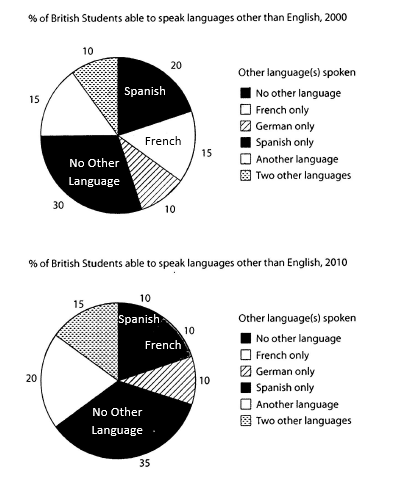
The charts below show the proportions of British students at one university in England who were able to speak other languages in addition to English, in 2000 and 2010
Summarise the information by selecting and reporting the main features, and make comparisons where relevant.
Student answer (Band 4.5)
"The pie chart illustrates the different british students of different languages in
addition to english between 2000 and 2010.
Overall,the no other language of british students accounted in other language accounted for
30%.whereas the smallest category wrere spinash acccounted for 20%.
The another language was 15%.
This was followed by the remaining categories,two another languages accounted for
10%which were remained same like the german langauge.
Another pie chart shows different british students.No other language
was propotion for 35%.The french was accounted for 10%.The german accounted for
10%was remained the same.
Another language was percentage for 20%.Finally,two other languages were accounted for
15%.Overall,the highest propotion of no other language was proportion for 35%.
and the lowest percentage was accounted for 10%.
AI examiner evaluation
| Criterion | Band |
|---|---|
| Task Achievement / Task Response | 4.0 |
| Coherence and Cohesion | 4.5 |
| Lexical Resource | 4.5 |
| Grammatical Range and Accuracy | 4.5 |
| Overall | 4.5 |
Task Achievement / Task Response: Band 4.0
You identify the two years and report several relevant figures, including the rise in “No other language” from 30% to 35% and the 2010 figures for French, German, “Another language” and “Two other languages.” However, coverage is incomplete: the 2010 Spanish figure is omitted, and the 2000 figures are not all clearly assigned to categories. The overview is also inaccurate when it calls Spanish the smallest 2000 category at 20%; German and two other languages were both 10%. The response is under the required 150 words, which limits the detail and comparison provided. To improve, give a clear overview of the main changes and compare the categories accurately across both charts.
Coherence and Cohesion: Band 4.5
There is a basic attempt to organise the response by discussing 2000 first and then 2010, and phrases such as “This was followed by” and “Finally” signal sequence. However, the progression is difficult to follow because the writing is broken into many short, widely separated lines, and there are no clear paragraph divisions for an introduction, overview and details. Some links are unclear or repetitive: “Overall” appears twice, while “The another language” and “This was followed by the remaining categories” do not make the relationships between figures easy to track. Group the two years into purposeful paragraphs and use direct comparisons, such as “Spanish fell from 20% to 10%,” to create a clearer progression.
Lexical Resource: Band 4.5
The response uses a small set of task-related terms, including “accounted for,” “percentage,” “category” and “proportion,” so the reader can recognise that it describes chart data. However, vocabulary is basic and repetitive, with “accounted for” and “proportion” used repeatedly and sometimes in unnatural combinations, as in “No other language of British students accounted in other language accounted for 30%.” Several spelling errors, including “spinash,” “propotion” and “langauge,” also reduce clarity. Use a more varied and accurate range of reporting language, such as “stood at,” “made up,” “rose” and “fell,” and check spelling carefully. Prefer precise category labels from the chart, such as “students speaking two other languages.”
Grammatical Range and Accuracy: Band 4.5
Most sentences rely on simple reporting patterns, and there is little evidence of controlled complex sentence structures. Errors in sentence formation and word order often make the meaning difficult to follow, for example, “The another language was 15%” and “No other language was propotion for 35%.” There are also problems with articles, agreement and punctuation, including “the smallest category wrere” and the missing space after “Overall,”. Some intended meanings can still be inferred, but the frequent errors and fragments prevent consistently clear reporting. Practise complete subject–verb sentences with a clear category and figure, for example, “The proportion speaking another language was 15%,” and use consistent punctuation and capitalisation.
See this exact question answered at other band scores. The same prompt compared across bands.
Browse more IELTS Writing model answers or get your own writing scored by the same AI examiner.