Band 5.0 IELTS Writing Task 1 Model Answer
Overall Band Score: 5.0 · Cambridge IELTS 11 · 2026-11-16
IELTS Writing Task 1 question
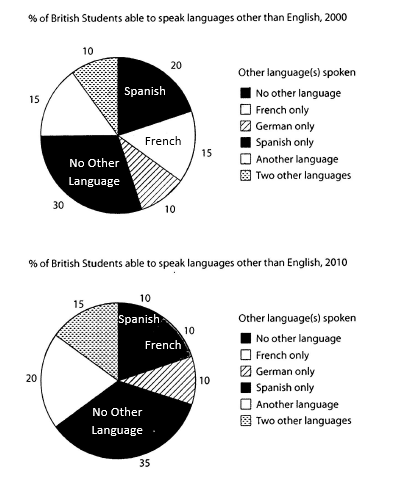
The charts below show the proportions of British students at one university in England who were able to speak other languages in addition to English, in 2000 and 2010
Summarise the information by selecting and reporting the main features, and make comparisons where relevant.
Student answer (Band 5.0)
The charts below demonstrate the proportions of British students at one university in England who were able to speak other languages in addition to English,in 2000 and 2010.
Overall, the number of British students who were able to speak english in year 2010 recorded to be higher than 2000.But the students who speak english only were less in 2000.
Initially in 2000,there were 30% of British students who were not able to speak other language except English.10% only were capable to speak German language other than English.Spanish language was most popular among 20% of Britian students.French was spoken by 15% of student only.Only 10 percent of students were involved conversating in 2 different languages other than English.Moreover,about 15 percent of students were capable to speak in another language other than English.
In 2010,the number of british students who are not capable to speak english increases than 2000 from 30 to 35 percent.The students who speaks German numbers remains the same .15 % of students are able to speak more than English.Almost 20 percent of students involved in speaking another language .Spanish and French speakers decreases from 15 to 10 percentage.
AI examiner evaluation
| Criterion | Band |
|---|---|
| Task Achievement / Task Response | 4.5 |
| Coherence and Cohesion | 5.5 |
| Lexical Resource | 5.0 |
| Grammatical Range and Accuracy | 5.0 |
| Overall | 5.0 |
Task Achievement / Task Response: Band 4.5
The response includes figures for both years and identifies several relevant categories, including the rise in “Another language” from 15% to 20% and the unchanged German figure. However, the overview is inaccurate: it says more students could speak English in 2010, whereas the charts show the share speaking no other language increased from 30% to 35%. The statement that students who “speak english only were less in 2000” is also unclear and conflicts with the data. Spanish fell from 20% to 10%, not from 15% to 10%, so the final comparison misreports a key change. The response reports details but does not give a reliable overall summary of the main trends; a clear, accurate overview and careful checking of figures are needed.
Coherence and Cohesion: Band 5.5
The response has a basic, useful structure: an opening, an overview, and separate paragraphs for 2000 and 2010. This makes the two years easy to distinguish, and words such as “Initially” and “Moreover” help connect details. However, progression is weakened by the inaccurate and unclear overview, and the 2010 paragraph moves through categories without a clear comparison framework. Some links are awkward or repetitive, such as “The students who speaks German numbers remains the same,” which makes the relationship between the subject and the comparison difficult to follow. Grouping categories by whether they rose, fell, or stayed unchanged would create a clearer progression and make comparisons more cohesive.
Lexical Resource: Band 5.0
The response uses enough topic vocabulary to identify the chart categories, including “proportions,” “German,” “Spanish,” and “another language.” It also attempts some variation with phrases such as “most popular” and “capable to speak.” However, the range is limited and several choices are inaccurate or unnatural, sometimes obscuring the intended meaning. For example, “involved conversating” is not an appropriate way to describe language ability, and “not capable to speak english” wrongly suggests inability rather than the chart category of speaking no other language. Repeated use of “students” and “speak” also makes the account less precise. Use standard chart language and accurate category labels consistently.
Grammatical Range and Accuracy: Band 5.0
The response communicates its basic meaning through mostly simple statements and makes some attempts to combine information, for example, “Spanish and French speakers decreases from 15 to 10 percentage.” However, the range of sentence structures is limited, and errors in agreement, tense, articles, and sentence boundaries are frequent. Examples include “The students who speaks,” “the number … increases,” and “German numbers remains,” where the verb forms do not agree with their subjects. The opening also has a comma splice and missing spacing after punctuation. These recurring errors make some comparisons harder to understand. Practise forming accurate past-tense sentences and checking subject–verb agreement before attempting more complex comparisons.
See this exact question answered at other band scores. The same prompt compared across bands.
Browse more IELTS Writing model answers or get your own writing scored by the same AI examiner.