Band 5.0 IELTS Writing Task 1 Model Answer
Overall Band Score: 5.0 · Cambridge IELTS 11 · 2026-11-16
IELTS Writing Task 1 question
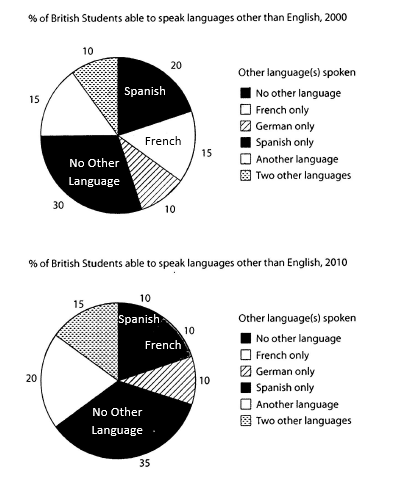
The charts below show the proportions of British students at one university in England who were able to speak other languages in addition to English, in 2000 and 2010
Summarise the information by selecting and reporting the main features, and make comparisons where relevant.
Student answer (Band 5.0)
The charts illustrate that percentage of students who speaks two other languages are increased in year 2010 cpared to earlier, which i think i a good thing for students to communicate and socialize with others. While the proportions of those students who do not know other then their mother tounge are gradualy increaded from 30% to 35%.Furthermore, the students who speaks another language which is not stated are also get a spike of 5% in these 10 years gap. Additionlly, French and Spanish Speaking students along with English both decreases in 2010. In 2000, 20% students speaks Spanish and 15% French but now only 10% students speaks Spanish and also same goes with French.Now if we talk about those students who can speank two other languages along with English also increases by 5% while only the proportion remained constant for students who speaks German with their native language. So by comparing we come to know that students who speaks other Languages with English decreases in these years.
AI examiner evaluation
| Criterion | Band |
|---|---|
| Task Achievement / Task Response | 5.5 |
| Coherence and Cohesion | 4.5 |
| Lexical Resource | 5.5 |
| Grammatical Range and Accuracy | 5.0 |
| Overall | 5.0 |
Task Achievement / Task Response: Band 5.5
You identify several important changes, including the rise in students reporting no other language (30% to 35%) and the increases for another language and two other languages. You also accurately compare Spanish and French, and note that German remains unchanged. However, the opening claim that students speaking “two other languages” increased is too broad: the chart shows a rise in that specific category, not an overall increase in multilingual students. Your final statement that students speaking other languages decreased contradicts the increases you have just described. The response also adds an opinion about communication and socialising, which is not required for a chart summary. A clearer overview of the main pattern, followed by precise comparisons, would make the report more complete and consistent.
Coherence and Cohesion: Band 4.5
The response includes a sequence of comparisons and uses linking expressions such as “Furthermore,” “Additionally,” and “while,” so the reader can follow some of the changes. However, the ideas are presented as one continuous paragraph, without a clear overview separated from supporting details. Several transitions feel mechanical, and the final sentence conflicts with the earlier comparisons rather than drawing them together. The repeated shifts between categories also make the progression difficult to track. Organise the report into an introduction and overview, then group the figures into clear comparisons—for example, categories that rose, those that fell, and the unchanged German figure. Use linking words only where they clarify the relationship between points.
Lexical Resource: Band 5.5
You use relevant chart vocabulary, including “proportions,” “remained constant,” “increases,” and “decreases,” and these choices help communicate the main comparisons. However, the range is limited and some expressions are imprecise or unnatural, such as “get a spike of 5%,” “in these 10 years gap,” and “students who speaks.” There are also noticeable spelling errors, including “cpared,” “gradualy,” “tounge,” and “Additionlly,” which reduce the accuracy and polish of the report. Aim for standard, precise language for describing data, such as “rose by five percentage points” or “over the decade.” Check spelling carefully and avoid informal or evaluative wording that does not describe the chart.
Grammatical Range and Accuracy: Band 5.0
You attempt some longer sentences using clauses and contrast, as in “While the proportions … increased from 30% to 35%,” but control is inconsistent. Subject–verb agreement errors recur: “students who speaks” should be “students who speak,” and “students … decreases” should be “students … decrease.” There are also problems with articles and sentence construction, for example, “that percentage of students” and “In 2000, 20% students speaks Spanish.” Punctuation is sometimes missing after full stops, as in “35%.Furthermore,” and several sentences run together. These errors can make the relationships between ideas harder to understand. Practise accurate simple comparisons first, then combine them with subordinate clauses while checking agreement, articles, and sentence boundaries.
See this exact question answered at other band scores. The same prompt compared across bands.
Browse more IELTS Writing model answers or get your own writing scored by the same AI examiner.