Band 5.5 IELTS Writing Task 1 Model Answer
Overall Band Score: 5.5 · Cambridge IELTS 11 · 2026-11-16
IELTS Writing Task 1 question
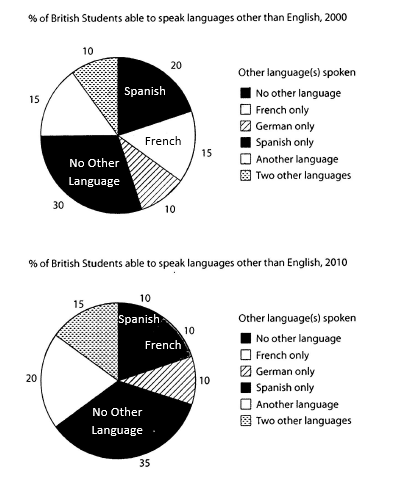
The charts below show the proportions of British students at one university in England who were able to speak other languages in addition to English, in 2000 and 2010
Summarise the information by selecting and reporting the main features, and make comparisons where relevant.
Student answer (Band 5.5)
The two pie charts compares the percenatges of Britsh learner at one university whoes were able to speak foregin languages with english at one university in England during 2000 and 2010.
Overall,native speakers with no other language was the largest proportion in the both periods, followed by the other languages speakers.In contrast, germany only speakers had unchanged figures in both years.
In 2000,britsh students just talked english accounted for 30%,followed by 20% for spanish and 15% for both frensh and another language , also students who talked only germany and two another langauges had the smallest shares at 10% for both.
In 2010, learner who talked no other langauge stayed the largest rate with 35%,with a slight rose in another languages speakers at 20%,followed by 15% for students spook two another langauge,while spanish and germany learner stood at 10%, frensh speakers declined minimally to 10% comapred with proportion of 2000.
AI examiner evaluation
| Criterion | Band |
|---|---|
| Task Achievement / Task Response | 6.0 |
| Coherence and Cohesion | 6.5 |
| Lexical Resource | 5.0 |
| Grammatical Range and Accuracy | 5.0 |
| Overall | 5.5 |
Task Achievement / Task Response: Band 6.0
You identify the main overall pattern: students speaking no other language formed the largest group in both years, while the German-only share remained unchanged. You also report several key figures accurately, including the 2000 shares for Spanish and French and the 2010 figures for no other language and other languages. However, the overview is not fully precise: “other languages speakers” is described as the second-largest group, although in 2000 Spanish was larger, and the 2010 ranking is not clearly stated. Some comparisons are also underdeveloped; for example, you could directly highlight the fall in Spanish from 20% to 10% and the rise in the two-other-languages group from 10% to 15%. Overall, the main features are covered, but some are unclear or not fully compared.
Coherence and Cohesion: Band 6.5
The response has a clear four-part structure: an introduction, an overview, and separate descriptions of the two years. This gives the reader a generally logical route through the information, and phrases such as “In 2000” and “In 2010” help signal the shift between chart years. The overview also usefully groups the largest category and the unchanged German figure. However, some sentences contain many figures and comparisons joined together, especially the final sentence, making the relationships harder to follow. Commas are often attached to the preceding word, and transitions such as “also” and “while” do not always make the comparison precise. More clearly separated sentences and consistent punctuation would make the progression smoother and the links less mechanical.
Lexical Resource: Band 5.0
You use some relevant chart vocabulary, including “proportion,” “accounted for,” “shares,” and “declined,” and the reader can generally understand the categories being compared. However, the range is limited and several word choices or forms are inaccurate enough to make parts of the report awkward. For example, “native speakers with no other language” does not accurately describe students who speak only English, while “stayed the largest rate” and “slight rose” are unnatural expressions. There are also frequent spelling errors, including “percenatges,” “Britsh,” “frensh,” and “langauges.” Aim for precise category labels and standard collocations, such as “the proportion of students” and “the share increased.” Proofreading spelling would also improve clarity.
Grammatical Range and Accuracy: Band 5.0
You attempt both simple and more complex sentence forms, including comparisons joined with “while” and participial phrases such as “followed by.” However, control is inconsistent, and errors in agreement, articles, and sentence construction sometimes make the meaning difficult to process. For instance, “The two pie charts compares” has a subject–verb agreement error, and “the largest proportion in the both periods” has an unnecessary article. The opening sentence also has a faulty relative clause in “learner … whoes were able.” Several long sentences combine multiple clauses and figures without clear punctuation, particularly the final paragraph. Build accuracy first with shorter, complete sentences, then add complex comparisons while checking agreement, articles, and clause structure.
See this exact question answered at other band scores. The same prompt compared across bands.
Browse more IELTS Writing model answers or get your own writing scored by the same AI examiner.