Band 5.0 IELTS Writing Task 1 Model Answer
Overall Band Score: 5.0 · Cambridge IELTS 11 · 2026-11-17
IELTS Writing Task 1 question
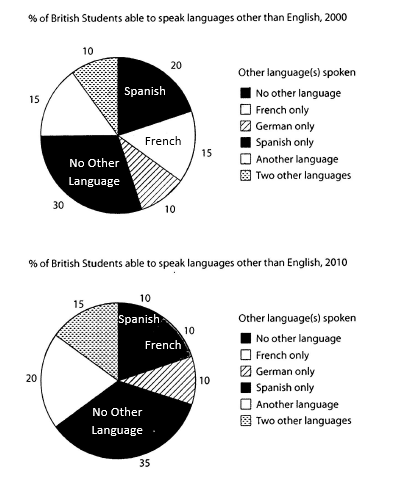
The charts below show the proportions of British students at one university in England who were able to speak other languages in addition to English, in 2000 and 2010
Summarise the information by selecting and reporting the main features, and make comparisons where relevant.
Student answer (Band 5.0)
The pie charts illustrate the proportions of British students at one university in England who were able to speak different languages in addition to English, between2000 and 2010.
Overall, it is evident that the number of british students only speaks english is more than that other language during the period of 2000 that are total of 30% from other language, however only few of students relatively 10% of students who speaks german and also 10% students speaks two other languages.
In 2000, the majority of students in univerity only speals english which atleat 30% of the total students in univerity, however 20% speaks spanish and there was equal amount of student like 15% speaks french and 15% spaek another language other than english, in contrast the only 10% students speaks german tat is equilant to 10% students that were capability to speaks more than 2 languages.
By 2010, the students who speaks english were become 35% of the toatl students, however, the stents who speaks spanish only were 10% from 100% and the amounts of students that speaks another language increse from 15
AI examiner evaluation
| Criterion | Band |
|---|---|
| Task Achievement / Task Response | 4.5 |
| Coherence and Cohesion | 5.5 |
| Lexical Resource | 5.0 |
| Grammatical Range and Accuracy | 5.0 |
| Overall | 5.0 |
Task Achievement / Task Response: Band 4.5
You identify the two years and report several relevant figures, including the rise in students speaking no other language from 30% to 35% and the 2000 figures for Spanish, French and German. However, the response only partially summarises the charts: the 2010 account stops mid-comparison, and there is no clear overview of the main changes across both years. Some descriptions are also inaccurate or unclear: “speaks more than 2 languages” does not match the chart’s category of “two other languages,” and the opening comparison confuses students speaking no other language with those speaking another language. To improve, give a concise overview, complete the 2010 comparisons, and report the categories and changes precisely.
Coherence and Cohesion: Band 5.5
The response has a recognisable structure: an introduction, an overview-like paragraph, and separate descriptions of 2000 and 2010. This gives the reader some sense of how the information is organised. However, progression is weakened by unclear comparisons and repeated use of “however,” which does not always express a contrast. For example, the overview combines the 30% with “other language” in a confusing way, and the final paragraph ends before completing its comparison. Use one paragraph for the overview and one for each year, and connect figures by category or change rather than relying on the same linking word. Clearer referencing would also help readers follow which group each percentage describes.
Lexical Resource: Band 5.0
You use some task-relevant vocabulary, such as “proportions,” “majority,” “equal amount,” and “in contrast,” and the reader can generally recognise the categories being discussed. However, the range is limited and several word-choice, spelling, and collocation errors make parts difficult to understand. Examples include “only speals english,” “the stents,” “were become,” and “capability to speaks.” Some category labels are also imprecise: “speaks more than 2 languages” changes the meaning of “two other languages.” Learn and reuse accurate chart language such as “accounted for,” “the proportion of students,” and “could speak two other languages,” while checking spelling and choosing terms that match the chart exactly.
Grammatical Range and Accuracy: Band 5.0
You attempt longer sentences and use contrast clauses, for example, “In 2000 …, however …,” so there is some effort to go beyond simple statements. Nevertheless, the range is limited, and errors in sentence structure, verb forms, agreement, and articles occur frequently enough to make several sentences difficult to follow. In “the number of british students only speaks english is more,” the subject and verb do not agree and the clause is not formed clearly. “The students who speaks english were become 35%” also combines an incorrect relative-clause verb with an inaccurate tense construction. Practise accurate patterns such as “The proportion of students who spoke no other language rose to 35%” and check subject–verb agreement in each sentence.
See this exact question answered at other band scores. The same prompt compared across bands.
Browse more IELTS Writing model answers or get your own writing scored by the same AI examiner.