Band 6.0 IELTS Writing Task 1 Model Answer
Overall Band Score: 6.0 · Cambridge IELTS 11 · 2026-11-17
IELTS Writing Task 1 question
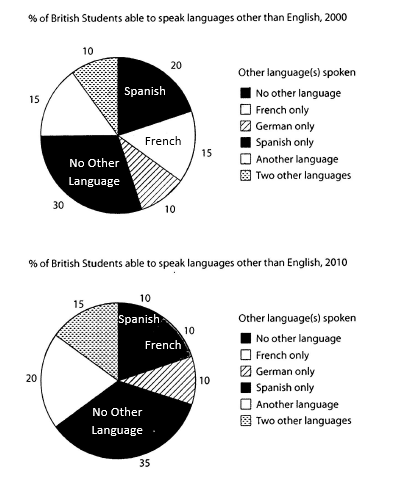
The charts below show the proportions of British students at one university in England who were able to speak other languages in addition to English, in 2000 and 2010
Summarise the information by selecting and reporting the main features, and make comparisons where relevant.
Student answer (Band 6.0)
The charts illustrate the percentage of British students who were fluent in other languages along with English at one particular university in England, in 2000 and 2010.
The students who were not able to speak any other language accounted for the largest proportion, 30% in 2000 and 35% in 2010. The proportion of students who were able to speak another language rose from 15% to 20% in these years. Similar pattern can be noticed for students who knew two language other than English, increased from 10% to 15%.
Turning to Spanish and French speaker students, a different pattern can be observed. In 2000, 20% of students could speak Spanish, while this number decreased in 2010 to 10%. Similarly, French speaking students' percentage decreased to 10% in 2010 which was 15%in 2000. The percentage for german speaker remained the same for both years at 10%
Overall, students who were not able
AI examiner evaluation
| Criterion | Band |
|---|---|
| Task Achievement / Task Response | 5.5 |
| Coherence and Cohesion | 5.5 |
| Lexical Resource | 6.0 |
| Grammatical Range and Accuracy | 6.0 |
| Overall | 6.0 |
Task Achievement / Task Response: Band 5.5
You report several key figures accurately: no other language is the largest category in both years, rising from 30% to 35%; “another language” and “two languages” also increase, while Spanish and French decline and German remains at 10%. These comparisons show a relevant understanding of the charts. However, the response does not provide a complete overview: its final sentence, “Overall, students who were not able…”, is unfinished, so the main trends are not clearly summarised at the end. Some categories are also described imprecisely, particularly “another language,” which should be distinguished from the separate “two other languages” category. Complete the overview and state the broad contrast between declining named-language categories and growth in the other-language categories.
Coherence and Cohesion: Band 5.5
The response has a generally understandable sequence: it first discusses categories that increased, then contrasts these with Spanish, French and German. Paragraphing helps separate the groups, and phrases such as “Turning to” and “Similarly” guide the reader through comparisons. However, the progression is weakened by the unfinished final sentence, which leaves the conclusion incomplete and makes the overall structure feel abrupt. Some links are also mechanical or unclear, as in “Similar pattern can be noticed… increased from 10% to 15%,” where the relationship between the two clauses is not smoothly expressed. Use a complete overview paragraph and connect each comparison with clear, grammatically complete sentences.
Lexical Resource: Band 6.0
You use an adequate range of task-related vocabulary, including “accounted for the largest proportion,” “rose,” “decreased,” and “remained the same.” These choices communicate the main movements in the data, and the response varies its wording rather than relying only on “went up” or “went down.” Some expressions are imprecise or awkward, however: “fluent in other languages along with English” suggests a level of fluency that the chart does not measure, while “Spanish speaker students” and “French speaking students’ percentage” are not natural collocations. Capitalisation is also inconsistent in “german.” Prefer neutral chart language such as “could speak” and concise category labels such as “Spanish speakers” or “the proportion speaking French.”
Grammatical Range and Accuracy: Band 6.0
There is a mix of simple and more developed sentence forms, and most of the data comparisons remain understandable. For example, “In 2000, 20% of students could speak Spanish, while this number decreased in 2010 to 10%” uses a clear contrast structure. Some grammatical errors remain: “Similar pattern” needs an article, and “students who knew two language … increased” has a faulty clause structure and plural form. The final sentence, “Overall, students who were not able,” is incomplete, while “which was 15%in 2000” has a missing space and awkward sentence construction. Check articles, plurals and clause completeness, and ensure every sentence has a finished main clause.
See this exact question answered at other band scores. The same prompt compared across bands.
Browse more IELTS Writing model answers or get your own writing scored by the same AI examiner.