Band 5.5 IELTS Writing Task 1 Model Answer
Overall Band Score: 5.5 · Cambridge IELTS 11 · 2026-11-18
IELTS Writing Task 1 question
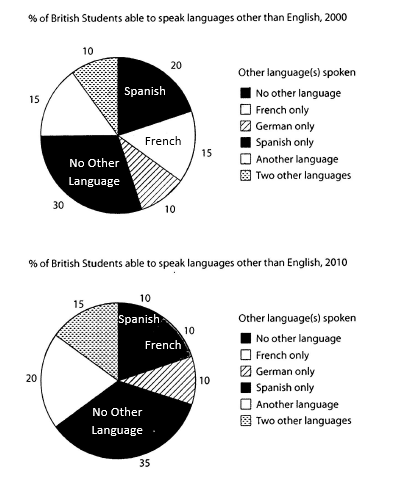
The charts below show the proportions of British students at one university in England who were able to speak other languages in addition to English, in 2000 and 2010
Summarise the information by selecting and reporting the main features, and make comparisons where relevant.
Student answer (Band 5.5)
The charts below compared two different year's proportions of british students who were able to speak other languages in addition to english.
Overall, first chart shows that, in 2000 , half of the students speak spanish and no other language and others were speak different languages. whereas, in 2010, the percentages of spanish and french were decreased and students who did not speak other language were increased respectively.
To begin with, In first chart, 30 percent of the student speak no other language than english, 20% of them were speak spanish. whereas, 15% of the individuals speak french and another language, while only 10 % of the students were know german and two other languages.
Furthermore, the amount in the no other languages were increased dramatically over 35%, and also rose in number of students who speak another languages and two other languages. Moreover, spanish and french speakers decresed by 10% and there were no changes mentioned who speak german language.
AI examiner evaluation
| Criterion | Band |
|---|---|
| Task Achievement / Task Response | 5.5 |
| Coherence and Cohesion | 5.5 |
| Lexical Resource | 5.5 |
| Grammatical Range and Accuracy | 5.0 |
| Overall | 5.5 |
Task Achievement / Task Response: Band 5.5
You identify several important changes, including the rise in students reporting no other language and the falls in Spanish and French. However, the overview is not fully accurate: saying that “half” of students spoke Spanish and no other language combines two separate categories, which total 50% but do not describe one group. The charts show that Spanish alone fell from 20% to 10%, while no other language rose from 30% to 35%. Your later comparisons are mostly relevant, but “increased dramatically over 35%” misstates the figure: it reached 35%, a five-point increase. Report the main categories separately and give precise comparisons to make the summary more complete and reliable.
Coherence and Cohesion: Band 5.5
The response has a recognisable structure: an introduction, an overview, and paragraphs describing the two years. This gives the reader a basic route through the information. However, progression is weakened by repeated and sometimes awkward linking, especially the repeated “whereas” and the opening “Furthermore” and “Moreover” in the final paragraph. The overview also combines Spanish and no other language in a way that makes the comparison unclear. Organise the details by comparing each category across both years, or group the rising and falling categories, and use clear references such as “this figure” only when the category is unmistakable. More controlled paragraph links would make the account easier to follow.
Lexical Resource: Band 5.5
You use relevant chart vocabulary, including “proportions,” “percentages,” “speakers,” and “increased,” so the topic is generally clear. However, the range is limited and several word choices or collocations are inaccurate, such as “the amount in the no other languages,” “rose in number of students,” and “speak another languages.” These expressions make some comparisons less natural or precise. There are also spelling and capitalisation slips, including “decresed” and inconsistent use of “English” and “Spanish.” Aim for accurate phrases such as “the proportion of students,” “the figure rose,” and “students who spoke another language.” This would improve precision without requiring more elaborate vocabulary.
Grammatical Range and Accuracy: Band 5.0
You attempt both simple and longer sentences, but control is inconsistent, and errors occur in basic verb forms, agreement, articles, and sentence boundaries. For example, “the students speak Spanish” and “were speak Spanish” do not use the past tense consistently, while “the student speak” has a subject–verb agreement problem. The sentence beginning “Overall” also joins ideas with a lower-case “whereas” after a full stop, and several commas are separated from the preceding word. These errors sometimes make the relationships between figures harder to understand. Practise past-tense reporting forms such as “accounted for” and “rose,” and check each sentence for a clear subject, verb, and correctly punctuated clause.
See this exact question answered at other band scores. The same prompt compared across bands.
Browse more IELTS Writing model answers or get your own writing scored by the same AI examiner.