Band 5.0 IELTS Writing Task 1 Model Answer
Overall Band Score: 5.0 · Cambridge IELTS 11 · 2026-11-18
IELTS Writing Task 1 question
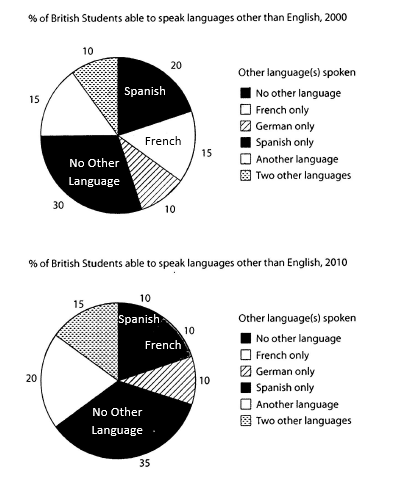
The charts below show the proportions of British students at one university in England who were able to speak other languages in addition to English, in 2000 and 2010
Summarise the information by selecting and reporting the main features, and make comparisons where relevant.
Student answer (Band 5.0)
The pie charts compare the proportions of British students at one university in England who were able to speak other than English in 2000 and 2010.
Overall, all languages rate increased over the period except, Spanish and French both languages rate decreased over the period. English language which means no other languages accounted for the highest spoken language in both the period. Additional, in 2010 same percentage of student spoken Spanish and French.
In 2000, 30% of British Students used English where as, only 10% students used german only and two other languages each. 15% pupils talked in french only and another language each. 20% readers spoken in spanish only.
In 2010, 35% pupils able to spoken in English no other language. 20% students spoken another language. 15% of British pupils used two other languages. Spanish and French merged and talked by each 10% students. Moreover, German languages spoken by 10% of pupils.
AI examiner evaluation
| Criterion | Band |
|---|---|
| Task Achievement / Task Response | 5.0 |
| Coherence and Cohesion | 5.5 |
| Lexical Resource | 5.0 |
| Grammatical Range and Accuracy | 5.0 |
| Overall | 5.0 |
Task Achievement / Task Response: Band 5.0
You identify the two years and report several key figures accurately, including the rise in “No other language” from 30% to 35%, and the changes in Spanish, French, and other languages. The overview also recognises the broad contrast between the growing no-language group and falling Spanish and French shares. However, the statement that “all languages rate increased” conflicts with the decreases you describe, and “English language” incorrectly interprets the no-other-language category: it means students spoke no additional language, not that English was a separate chart category. The response is also 13 words below the 150-word minimum. Develop a consistent overview and explain the main shifts more clearly.
Coherence and Cohesion: Band 5.5
The response has a recognisable structure: an introduction, an overview, and separate paragraphs for 2000 and 2010. This makes the year-by-year information reasonably easy to locate. However, progression is weakened by the contradictory overview (“all languages rate increased” followed by falling Spanish and French) and by awkward links such as “Additional” and “Moreover.” Some comparisons are scattered rather than grouped by trend, and the repeated sentence openings “In 2000” and “In 2010” make the organisation feel list-like. Grouping the categories that rose, fell, or stayed unchanged, then comparing them directly, would create a clearer line of development and more effective cohesion.
Lexical Resource: Band 5.0
You use relevant chart vocabulary such as “proportions,” “accounted for,” and “percentage,” and the category labels help communicate the data. However, the range is limited and several word choices or collocations are inaccurate, sometimes making the meaning difficult to follow. For example, “languages rate” is not a natural way to describe the figures, “readers spoken” is inappropriate for students, and “Spanish and French merged and talked by each 10%” does not clearly express that each category accounted for 10%. “English language” also mislabels the no-additional-language category. Use precise reporting phrases such as “the proportion of students speaking…” and retain the chart’s category meanings accurately.
Grammatical Range and Accuracy: Band 5.0
You attempt both simple statements and more developed sentences, including an overview with a contrast and several percentage comparisons. However, grammatical errors are frequent and sometimes make relationships unclear. Examples include “who were able to speak other than English,” “all languages rate increased,” and “35% pupils able to spoken,” which show problems with sentence structure, verb forms, and articles. The sentence “Spanish and French merged and talked by each 10% students” is also difficult to parse because its clause structure and passive form are faulty. Aim first for accurate patterns such as “35% of students spoke no other language” and “the figures for Spanish and French were both 10%.” Check articles, prepositions, and subject–verb forms throughout.
See this exact question answered at other band scores. The same prompt compared across bands.
Browse more IELTS Writing model answers or get your own writing scored by the same AI examiner.