Band 6.0 IELTS Writing Task 1 Model Answer
Overall Band Score: 6.0 · Cambridge IELTS 11 · 2026-11-18
IELTS Writing Task 1 question
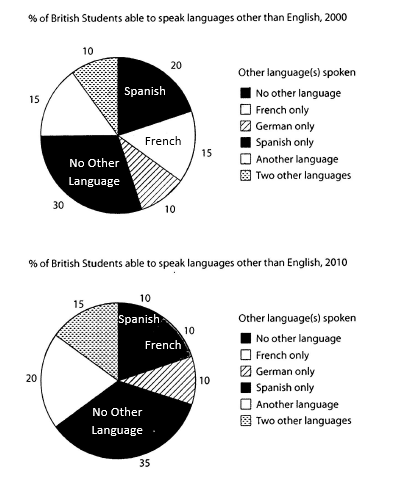
The charts below show the proportions of British students at one university in England who were able to speak other languages in addition to English, in 2000 and 2010
Summarise the information by selecting and reporting the main features, and make comparisons where relevant.
Student answer (Band 6.0)
The pie charts illustrates the percentages of british learners at particular university in England who can speak other languages apart from English in 2000 and 2010.
Overall, it is notable that students were not able to speak any other language in the two distinct years. Those who can speak two other languages and french only rose sligtly while spanish, french and German only speakers reduced.
In 2000, those who can speak no other language apart from English dominated a larger portion of 30%.On the other hand , those who can speak English and German only and other two languages had the little proportion of each 10%. Likewise, French only speakers and Another language each was at 15%
In 2010, group of english speakers and they cannot speak other languages was again a dominant, with a slight increased from the previous year, to 35%. Those who are fluent in another language and other two languages had grown in relation to the prior year, having 20% and 15 consecutively. In regards to spanish speakers only, German only and French only, with English as main languages, each dropped to 10% being the lowest group.
AI examiner evaluation
| Criterion | Band |
|---|---|
| Task Achievement / Task Response | 6.0 |
| Coherence and Cohesion | 6.5 |
| Lexical Resource | 5.5 |
| Grammatical Range and Accuracy | 5.5 |
| Overall | 6.0 |
Task Achievement / Task Response: Band 6.0
You cover both years and report several key figures accurately: for example, the no-other-language group rises from 30% to 35%, while “another language” increases from 15% to 20%. You also identify the growth in the two-other-languages group. However, the overview is unclear and partly contradictory: “students were not able to speak any other language” sounds like a general conclusion, while the next sentence says some groups rose and others fell. Spanish-only speakers fell from 20% to 10%, but your overview does not clearly identify this as a notable change. Also, French-only speakers fell, whereas the phrase “french only rose slightly” reverses the trend. A clearer overview and more precise comparisons would make the main features easier to understand.
Coherence and Cohesion: Band 6.5
The response has a recognisable structure: an introduction, an overview, and separate paragraphs for 2000 and 2010. This gives the information a coherent overall arrangement, and time markers such as “In 2000” and “In 2010” help readers follow the comparison. Some linking and referencing, however, are awkward or unclear. “Those who can speak two other languages and french only rose slightly” does not clearly distinguish the two groups, and “the previous year” is inaccurate for a comparison between 2000 and 2010. The final sentence also groups three categories together without a smooth explanation of their shared value. Use clearer transitions and refer to the years as “the earlier year” or “2000” to improve progression.
Lexical Resource: Band 5.5
You use a reasonable range of task-related vocabulary, including “dominated,” “proportion,” “fluent,” and “in relation to,” so the main comparisons are generally understandable. However, several choices are inaccurate or unnatural for describing chart data. “Students were not able to speak” suggests inability rather than the chart category of speaking no additional language, while “had the little proportion” and “had grown in relation to the prior year” are awkward collocations. There are also spelling and form errors, including “sligtly,” “british,” and “consecutively.” Aim for precise chart language such as “accounted for,” “increased,” and “respectively,” and check spelling and capitalisation.
Grammatical Range and Accuracy: Band 5.5
You attempt both simple and more complex sentence forms, including the contrast introduced by “On the other hand” and the longer sentence beginning “Those who are fluent…”. The overall meaning is usually recoverable, but some grammatical errors remain. The opening has subject–verb disagreement in “The pie charts illustrates,” and “at particular university” is missing an article. In “Those who can speak no other language… dominated a larger portion,” the tense and phrasing do not fit smoothly; “accounted for 30%” would form a clearer sentence. Punctuation spacing is also inconsistent, as in “30%.On the other hand,” and some sentence structures become difficult to follow. Review agreement, articles, tense consistency, and sentence boundaries.
See this exact question answered at other band scores. The same prompt compared across bands.
Browse more IELTS Writing model answers or get your own writing scored by the same AI examiner.