Band 5.0 IELTS Writing Task 1 Model Answer
Overall Band Score: 5.0 · Cambridge IELTS 11 · 2026-11-18
IELTS Writing Task 1 question
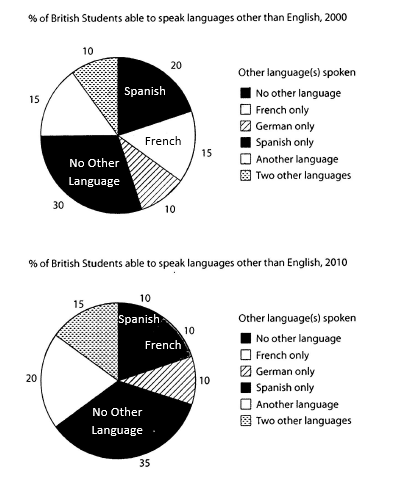
The charts below show the proportions of British students at one university in England who were able to speak other languages in addition to English, in 2000 and 2010
Summarise the information by selecting and reporting the main features, and make comparisons where relevant.
Student answer (Band 5.0)
The two bar charts illustrates the numbers of British students at the same universty who speaks more then one language a part from english from 2000 to 2010.
overall, the students who were not able to speak any other languages dominated the charts in both years.
In 2000, students who speaks only english accounted for the largest propotions making up over one-third of the pie, spanish ranked second and made up 20% of the total, french and another language speakers represented quarter of the students, german and two another languages were the smallest number at 10%.
2010, the number only english speakers increased , along with people who speak another language to 35% and 20% respectfully. so does the speakers two other languages to 15%, french and spanish declined to 10% and german remained the same making up 10% of the total
AI examiner evaluation
| Criterion | Band |
|---|---|
| Task Achievement / Task Response | 5.0 |
| Coherence and Cohesion | 5.5 |
| Lexical Resource | 5.0 |
| Grammatical Range and Accuracy | 5.0 |
| Overall | 5.0 |
Task Achievement / Task Response: Band 5.0
You identify the broad pattern that students speaking no other language formed the largest group in both years, and you report several relevant figures, including Spanish falling from 20% to 10% and German remaining at 10%. However, the response only partially covers the task: the overview is brief, and some comparisons are unclear or inaccurate. In 2000, French and “another language” were each 15%, together making 30%, not a quarter; the largest category, no other language, was 30%, not “over one-third.” The 2010 figures are also expressed ambiguously as increases “to 35% and 20%.” The response is 142 words, below the required 150. Add a clearer overview and accurately compare the main categories across both years.
Coherence and Cohesion: Band 5.5
The response has a basic overall structure: an introduction, an overview, and a paragraph for each year’s information. This gives the reader a general route through the data. However, progression within the final paragraph is weakened by the compressed sequence of figures and the connector “so does,” which makes the relationship between the changes difficult to follow. The opening also calls the visuals “bar charts,” although they are pie charts, and the overview is not clearly separated from the detailed comparisons. Use distinct paragraphs for the overview and key details, and link comparisons explicitly—for example, contrast the declining Spanish and French shares with the increases in other-language categories.
Lexical Resource: Band 5.0
You use some relevant chart vocabulary, including “accounted for,” “ranked second,” “represented,” and “declined,” which helps communicate comparisons. However, the range is limited and several word choices or forms are inaccurate, sometimes making the data harder to interpret. “Numbers” is unsuitable for percentages, “proportions” is misspelled, and “respectfully” is used where “respectively” is intended. Phrases such as “two another languages” and “students who speaks” also show weak control of forms and collocations. Aim for precise terms such as “share,” “proportion,” and “category,” and check spelling and word forms before submitting. Avoid repeating “students” when a clear reference to a group is possible.
Grammatical Range and Accuracy: Band 5.0
The response attempts both simple statements and longer comparisons, but the range of sentence structures is limited and errors occur frequently. Subject–verb agreement is inconsistent in “charts illustrates” and “students who speaks,” while the opening sentence also has an unclear construction for describing the ability to speak additional languages. The final sentence is a fragment-like construction: “so does the speakers two other languages to 15%,” and the comma splice before “french and spanish declined” makes the comparison difficult to read. Capitalisation and punctuation are also inconsistent, particularly at sentence beginnings and with language names. Build accurate complete sentences first, then use controlled clauses such as “while” or “whereas” to compare the years.
See this exact question answered at other band scores. The same prompt compared across bands.
Browse more IELTS Writing model answers or get your own writing scored by the same AI examiner.