Band 5.5 IELTS Writing Task 1 Model Answer
Overall Band Score: 5.5 · Cambridge IELTS 11 · 2026-11-19
IELTS Writing Task 1 question
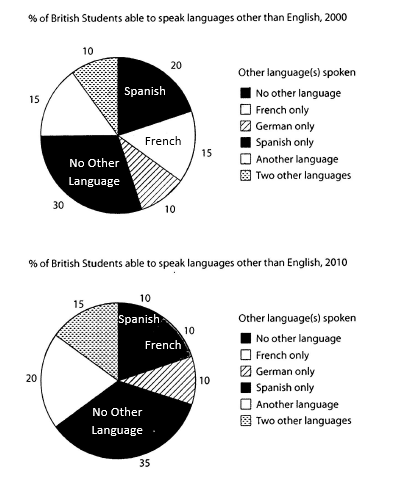
The charts below show the proportions of British students at one university in England who were able to speak other languages in addition to English, in 2000 and 2010
Summarise the information by selecting and reporting the main features, and make comparisons where relevant.
Student answer (Band 5.5)
The pie charts depict the ratio of British students at one university in England who were able to speak other languages in addition to English between 2000 and 2010.
Overall, it is clear that no other language accounted for the highest proportion of British students in both years, while the German only accounted for the lowest ratio of British students throughout the period.
In 2000, the percentage of no other language for British students leading with 30%, subsequently Spanish made up 20%, on the other hand French and Another language had same proportion 15%, followed by German only and Two other languages also made up similar ratio that is 10%.
In 2010, the no of other language, Another language and Two other languages rate increased significantly throughout the period consequently 35%, 20% and 15%, while German only have same proportion with 10% over the years, eventualy Spanish and French decreased over the period with the fraction of 10%.
AI examiner evaluation
| Criterion | Band |
|---|---|
| Task Achievement / Task Response | 5.5 |
| Coherence and Cohesion | 6.0 |
| Lexical Resource | 5.5 |
| Grammatical Range and Accuracy | 5.5 |
| Overall | 5.5 |
Task Achievement / Task Response: Band 5.5
You identify the main overall pattern: “No other language” is the largest category in both years, and you report the increases in “Another language” and “Two other languages” as well as the unchanged German figure. Most figures are accurate. However, the overview incorrectly calls German the lowest category throughout: in 2000, German and “Two other languages” were tied at 10%, and in 2010 Spanish, French and German were all at 10%. The comparison that Spanish fell from 20% to 10% is present but could be made clearer. The response also contains 139 words, below the required 150, which limits the development of the summary. Add a fuller comparison of the categories that rose, fell or remained stable.
Coherence and Cohesion: Band 6.0
The response has a clear four-part structure, with an introduction, an overview and separate paragraphs for 2000 and 2010. This makes the information easy to locate, and the year-by-year sequence is logical. Cohesion is less successful within some sentences: “subsequently” and “on the other hand” are used to connect a list of figures where simpler links would be clearer, while “consequently” does not express the intended relationship in the 2010 paragraph. The final sentence also combines several trends, making the comparisons harder to follow. Use shorter, more controlled sentences and group the categories by trend—for example, increases, decreases and no change—to create smoother progression.
Lexical Resource: Band 5.5
You use relevant chart vocabulary, including “proportion,” “percentage,” “accounted for” and “decreased,” and the reader can generally understand the comparisons. However, several expressions are unnatural or imprecise, such as “the percentage of no other language,” “the no of other language” and “leading with 30%.” “Ratio” is also not the best choice for describing these shares; “proportion” or “percentage” is more appropriate. There are noticeable spelling errors in “eventualy,” and some repetition of “over the period.” Aim for accurate, natural collocations and check spelling. A more precise range of verbs for describing chart changes would also help make the report clearer and more fluent.
Grammatical Range and Accuracy: Band 5.5
You attempt both simple and more complex sentence forms, and the overall meaning is usually recoverable. However, some sentences contain errors in clause structure and agreement. For example, “In 2000, the percentage of no other language for British students leading with 30%” is not a complete grammatical sentence, and “German only have same proportion” has incorrect subject–verb agreement and is missing an article. The sentence beginning “In 2010, the no of other language…” also joins several ideas without a clear grammatical structure. Use complete clauses with an explicit subject and verb, such as “The proportion of students speaking no other language was 30%.” Check articles, agreement and sentence boundaries when combining comparisons.
See this exact question answered at other band scores. The same prompt compared across bands.
Browse more IELTS Writing model answers or get your own writing scored by the same AI examiner.